Trading signals and trading bots are often grouped together because both can make the trading process more systematic. But they automate very different parts of that process.
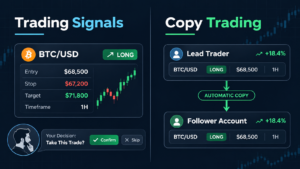
A trading signal identifies a potential opportunity. It may include the market, direction, entry, stop-loss, target, timeframe, and additional context, but the trader usually decides what happens next. A trading bot can take that process further. Depending on how it is built, it may monitor the market, identify a setup, calculate position size, place the order, manage the position, and close the trade automatically.
So the real difference is not necessarily how the trade idea is generated. It is where responsibility shifts from the trader to the system. That distinction is not absolute either. Signals can be generated automatically, and bots can act on signals produced by another system. In practice, trading signals and trading bots often sit at different points on the same automation spectrum.
1. Trading Signals vs Trading Bots: The Difference at a Glance
Here is how the two approaches generally compare:
| Area | Trading Signals | Trading Bots |
|---|---|---|
| Opportunity detection | Provider, analyst, algorithm, or AI system | Strategy, algorithm, or external signal |
| Final trade decision | Usually made by the trader | Usually determined by predefined rules |
| Order execution | Usually manual | Can be automatic |
| Position sizing | Usually decided by the trader | Can be calculated automatically |
| Stop-loss and targets | Suggested or predefined in the signal | Can be placed and managed automatically |
| Trade management | Often manual | Can be automated |
| Speed | Depends partly on trader response | Can react immediately when conditions are met |
| Human discretion | High | Usually lower |
| Technical setup | Relatively simple | Often requires more configuration and maintenance |
| Main dependency | Signal quality and trader execution | Strategy quality and execution infrastructure |
One important distinction is that a trading bot is not automatically an AI trading bot. Many bots are entirely rule-based. A system that buys when a fast moving average crosses above a slower moving average and exits when the opposite happens can be fully automated without using artificial intelligence at all.
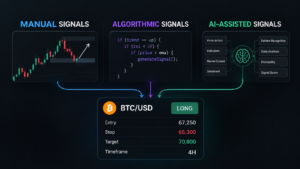
The same applies to trading signals. They can come from a human analyst, a fixed algorithm, an AI model, or a combination of different methods. Whether AI is involved tells us how the analysis may be produced. It does not tell us how much of the trading process has been automated.
2. The Real Difference Is How Far Automation Goes
Rather than dividing trading into “manual signals” and “automated bots,” it is more useful to look at how far automation extends through the process. A typical signal-based workflow might look like this:
Market Data → Analysis or Strategy → Signal → Trader → Order → Trade Management
The analysis may already be automated, but the trader remains between the signal and the actual trade. A more automated workflow might look like this:
Market Data → Strategy → Trading Condition → Risk Rules → Order → Trade Management
Once the required conditions are met, the system can continue through execution without waiting for manual approval. There are several possibilities between those two extremes:
Alert Only → Structured Signal → Automated Position Sizing → Automated Entry → Automated Entry and Exits → Fully Rule-Based System
For example, you could use TradingView to generate automated signals while placing every trade yourself. Another trader could take the same signal and send it through a webhook to an execution service while still managing the resulting trade manually.
A more complete bot could automate everything from setup detection and position sizing to entry and exit management. The useful question, therefore, is not simply whether a process is manual or automated. It is which decisions remain with the trader and which have been transferred to predefined rules.
3. Signals Give You More Discretion; Bots Give You More Consistency
Trading signals normally preserve a layer of human judgment between the setup and its execution.
You can reject a signal, reduce the position size, wait for a different entry, or decide that current market conditions do not justify taking the trade. You may also notice something the signal methodology does not account for, such as unusual volatility, poor liquidity, or an important economic announcement.
The same flexibility can lead to late entries, skipped setups, inconsistent position sizing, moved stops, or premature exits. A trader may even execute the same signal methodology differently depending on confidence, recent performance, or emotion. This is one reason the performance of a signal provider and the performance of the trader following those signals can diverge.
Read: Build Your First Trading Bot: A Simple TradingView Breakout Bot from Setup to Live AlertsTrading bots reduce much of that execution variability. If the system has been instructed to enter under specific conditions, calculate risk according to a defined rule, and exit using predetermined criteria, it can repeat that process without hesitation.
That consistency becomes particularly useful when speed matters or the same strategy needs to monitor several markets simultaneously. But consistency is not the same as correctness. A bot can execute a good rule consistently, but it can execute a bad rule just as consistently. It does not automatically know that a strategy has stopped working or that the surrounding market environment has changed unless the system has been designed to account for it.
Signals therefore leave more room for judgment, while bots leave less room for improvisation. Neither is inherently better. The trade-off is between discretion and repeatability.
4. Trading Signals and Trading Bots Fail in Different Ways
Both approaches can produce poor results even when everything appears to be working correctly. The difference is often where the failure occurs.
With trading signals, much of the execution risk exists between the signal and the trader. A valid signal can arrive on time, yet the trader may enter after price has moved, alter the suggested position size, skip the trade, move the stop-loss, or exit differently from the original plan.
With trading bots, more of that execution is standardized, but the system introduces different failure points.
| Trading Signals | Trading Bots |
|---|---|
| Signal arrives late | Alert or webhook fails |
| Trader enters late or chases price | Broker or exchange rejects the order |
| Valid signals are skipped | API or connection fails |
| Position size is changed | Incorrect sizing or order logic is triggered |
| Stops or targets are modified | Slippage differs materially from testing |
| Trade is closed early | Bot continues operating when it should be paused |
Bots also carry strategy-development risk. A system may be overfitted to historical data, rely on parameters that no longer suit the market, or perform differently when volatility, liquidity, spreads, and execution conditions change.
Ultimately, both signals and bots depend on the quality of the underlying trading logic. A useful way to evaluate either approach is to separate three questions:
- Does the underlying strategy actually have an edge?
- Is the signal or automated system identifying the setup correctly?
- Is the trade being executed as intended?
Perfect automation cannot rescue a poor strategy, just as perfect manual execution cannot turn unreliable signals into a profitable methodology.
5. Trading Bots Still Need Monitoring
Automated execution does not mean unattended trading.
A bot may remove the need to manually place every order, but the trader still needs to know whether the system is functioning as intended. That includes monitoring broker or exchange connectivity, order execution, position sizing, drawdown, spreads, slippage, and any unusual behavior from the strategy itself.
The work changes rather than disappearing.
With trading signals, your attention is usually concentrated around individual opportunities: reviewing the setup, deciding whether to take it, executing the trade, and managing the position.
With bots, more of that work moves toward testing, configuration, supervision, and maintenance.
This becomes increasingly important as the system grows more complex. Automated trading may involve alerts, APIs, webhooks, execution services, servers, broker permissions, and several layers of risk management.
Read: Automated Trading: Benefits, How Successful Traders Leverage BotsA well-designed system should therefore have safeguards beyond the strategy itself. These might include maximum daily loss, position-size limits, restrictions on simultaneous trades, or conditions that automatically pause execution when something unexpected happens.
Automation can reduce manual execution considerably. It does not remove the responsibility of supervising the system that is doing the executing.
6. Can You Turn Trading Signals Into an Automated Bot?
Yes. A trading signal can become the starting point of an automated execution system. A simplified setup could look like this: Signal Generator → Alert or Webhook → Risk & Execution Layer → Broker or Exchange
For example, a TradingView strategy or indicator could generate a signal when its conditions are met. Instead of sending only a notification to the trader, that signal could be passed through a webhook to an execution service.
The execution layer can then apply additional rules before an order reaches the broker. Depending on the system, those rules might control position size, maximum account risk, permitted markets, trading sessions, stop-loss placement, or whether the strategy should currently be allowed to trade.
This allows traders to automate as much or as little of the process as they want. You might automate position sizing while keeping final approval manual. You could automate entries while managing exits yourself. Or the entire process could run automatically from signal generation through trade management. The important part is that automation does not improve the underlying signal. If a methodology performs poorly, automating it only allows the same methodology to operate faster and more consistently.
That is why automation should normally follow validation rather than replace it. Historical testing, paper trading, and live execution data can help establish how a strategy behaves across different market conditions and whether real-world factors such as slippage, spreads, and losing streaks materially change its results.
The technology required to automate a signal is relatively straightforward compared with the more important question: Is the trading process robust enough to justify automating it?
7. Trading Signals or Trading Bots: Which Is Better for You?
The better choice depends on what you want to automate and how much control you want to retain.
| Trading Signals May Suit You Better If… | Trading Bots May Suit You Better If… |
|---|---|
| You want to approve each trade | You want rules executed automatically |
| You value discretion and additional market context | You value repeatability |
| You prefer controlling risk manually | Your sizing and risk rules are already defined |
| You want to review individual setups | Your strategy is clearly rule-based |
| You prefer a simpler technical setup | Speed or multi-market execution matters |
| You want to remain involved in execution | You are comfortable testing and maintaining automation |
For traders who are still developing their judgment, signals can also provide individual setups to evaluate rather than outsourcing the entire execution process. For a trader with a well-defined and properly tested rule set, however, repeatedly performing the same mechanical actions by hand may add little value.
There is also no requirement to choose one approach completely. A hybrid system might automate scanning and signal generation while leaving final approval with the trader. Another might automate entries, sizing, and exits while retaining account-level risk controls and human supervision.
The most useful distinction is therefore not human versus bot. It is deciding which parts of your trading process benefit from speed and consistency, and which still benefit from human judgment.

SM_Trader
SM_Trader is a highly experienced coder and strategy developer who brings the most complex algorithms to life. As a member of MENSA, the prestigious organization for individuals with intelligence scores in the top 2% of the world, he combines exceptional analytical skills with a keen eye for numbers and statistics, empowering businesses to grow at the right pace and in the right direction.
More from SM_Trader