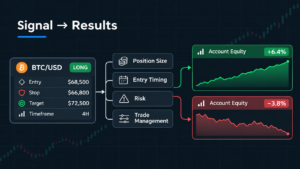
Trading signals and copy trading are often grouped together because both let you benefit from someone else’s market analysis. The key difference is what happens after the trade idea is created.
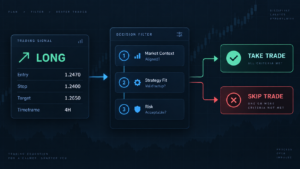
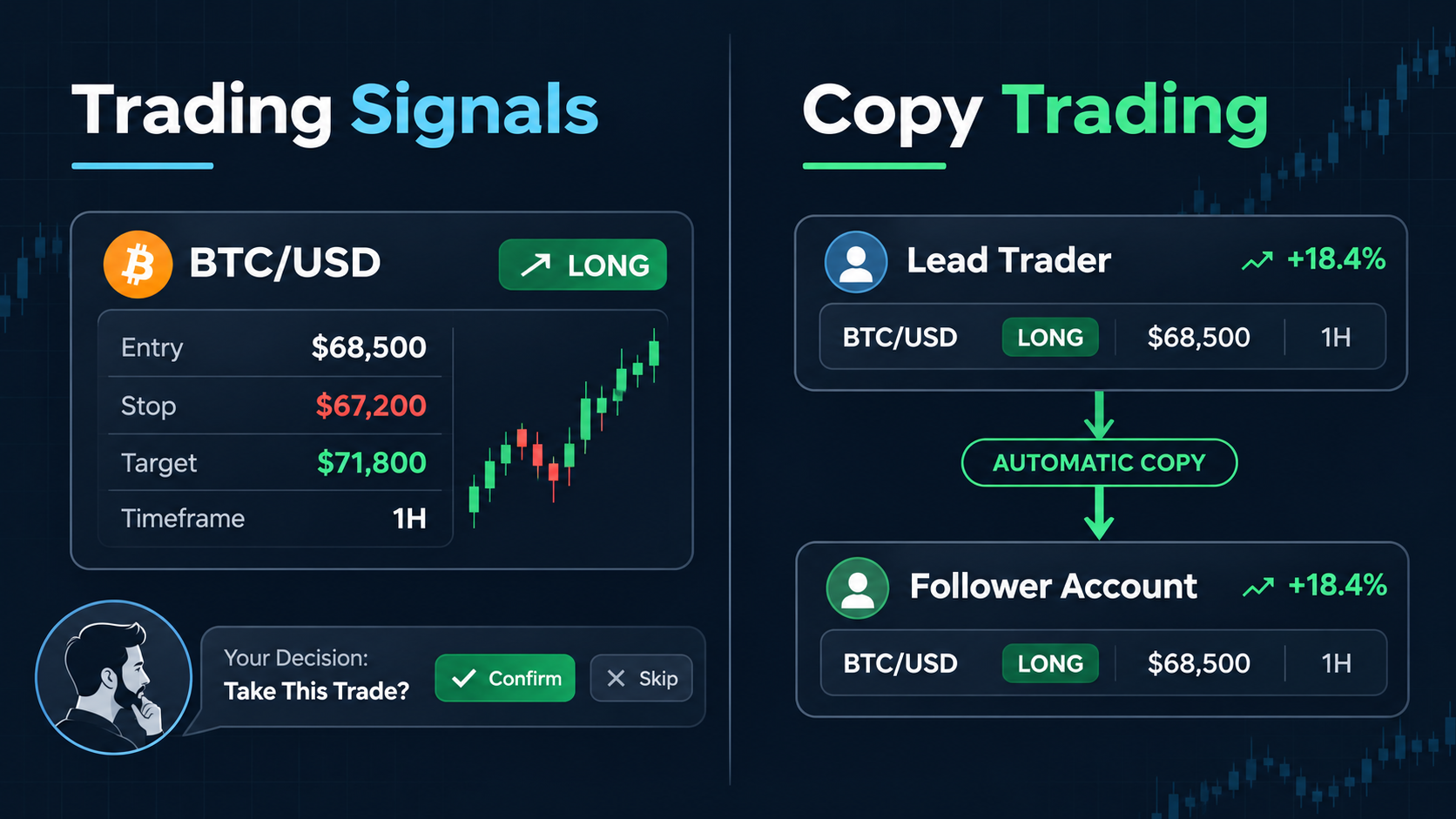
With trading signals, you receive the setup and decide whether you want to act on it. A provider might send you the market, direction, entry, stop-loss, target, and timeframe, but you still control whether the trade goes into your account and how you execute it.
Copy trading goes one step further. You choose a trader or strategy to follow, allocate capital, and the platform can automatically replicate that trader’s positions in your account based on the copy settings you choose. You are still making important decisions, but they usually happen at the level of who you copy, how much you allocate, and when you stop, rather than approving every individual trade.
That distinction changes almost everything else. So I wouldn’t ask whether trading signals or copy trading is universally better. The more useful question is how much control, involvement, and automation you actually want in your trading process.
1. Trading Signals vs. Copy Trading: Key Differences
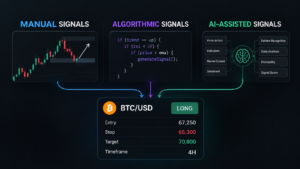
A trading signal is essentially a structured trade idea. Depending on the service, it may include an entry price or zone, stop-loss, profit targets, timeframe, and some explanation of the setup. You receive that information and decide whether to place the trade yourself.
With copy trading, the platform usually handles the trade decision automatically once you select the trader or strategy you want to follow. When the copied trader opens or closes a position, the platform attempts to replicate that action in your account based on your allocated capital and the platform’s copying rules.
| Trading Signals | Copy Trading | |
|---|---|---|
| Who finds the trade? | Signal provider | Copied trader or strategy |
| Who decides whether to take each trade? | You | Usually predetermined once copying is active |
| Who executes the trade? | You | Platform |
| Control over individual entries | High | Lower |
| Position sizing | You decide per trade | Usually based on allocation/copy settings |
| Time required | More active | Lower after setup |
| Can you skip individual trades? | Easily | Depends on the platform |
| Main dependency | Signal quality + your execution | Copied trader + platform execution + your allocation |
| Learning potential | Higher if you review each setup | Depends heavily on how much context the copied trader provides |
That creates a clear difference in responsibility: signals leave the final trade decision with you, while copy trading shifts more day-to-day execution to the platform. With trading signals, you usually keep control at the individual-trade level. However, the downside is that every additional decision creates room for execution differences. If you regularly enter late, skip trades after a losing streak, increase size on setups you feel strongly about, or close positions early, your results may drift quite far from the provider’s historical performance.
Copy trading changes where that responsibility sits. Once copying is active, the platform can automatically open and close individual trades. That removes some inconsistency, but with a critical trade-off. More control isn’t automatically better, and more automation isn’t automatically safer. A disciplined trader may benefit from having the freedom to evaluate every signal independently, whereas a less experienced trader might use that same freedom poorly.
Copy trading can reduce those manual mistakes, but it can just as easily reproduce every poor decision made by the trader you selected. Either way, the underlying strategy still matters.
Read: Mirror Trading: How to trade like Pros?2. How Your Results Can Differ in Each Model
With trading signals, most of the variation comes from your own execution. If a signal includes a defined entry, stop, and target, the provider’s recorded result usually assumes you took the trade according to those terms. The more you alter the original setup, the further your results can drift from the provider’s recorded performance. That is not necessarily a problem if those changes are intentional, but it does mean you are no longer following exactly the same process.
Even with copy trading, automatic execution does not mean identical execution. A copied trade can still be affected by slippage, liquidity, execution delay, account size, minimum order requirements, leverage, fees, and the platform’s own copying logic. If the lead trader gets filled at one price and your copy is executed slightly later, the two positions may already have different entries.
Those differences can become more noticeable in fast-moving or less liquid markets. A small amount of slippage may not matter much on a longer-term trade with a wide target, but it can materially affect a short-term strategy where the expected profit per trade is relatively small.
Account structure matters as well. The trader being copied may be using a different account size, leverage level, or allocation model from yours. Even when the same trade is replicated proportionally, the effect on your overall portfolio may not be identical.
3. Which One Helps You Learn More?
Trading signals usually require more active involvement because every alert still needs your attention. Depending on the service, you may need to review the setup, check whether the entry is still valid, decide how much to risk, place the order, and then manage the position once it is open. That can be inconvenient, particularly if the signals are short-term and arrive while you are away from the screen. But the extra involvement can also be useful because it forces you to engage with the trade itself. The process can have educational value if you’re looking to improve your analysis and decision-making.
Copy trading is much less demanding at the individual-trade level. Once you have chosen a trader, allocated capital, and configured the relevant settings, you can copy positions without reacting every time the lead trader does something. That makes it attractive for people who do not want to monitor alerts throughout the day. The trade-off is that automation can make it easier to become detached from what is actually happening inside the account. Watching another trader’s positions appear and disappear does not necessarily teach you why those trades were taken, what conditions they were based on, or how the strategy is supposed to behave.
So I wouldn’t assume copy trading is automatically a better learning tool just because you can observe another trader’s activity. It can provide useful exposure to how someone manages a portfolio, but that is not the same as understanding the reasoning behind the trades.
Read: How to Use Trading Signals Without Blindly Following Them4. What Should You Evaluate Before Choosing Either One?
With trading signals, you are judging the quality of the signal process. With copy trading, you place much more weight on the trader or strategy you’re copying, as well as how the platform translates their activity into your account.
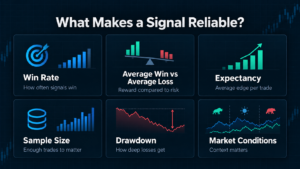
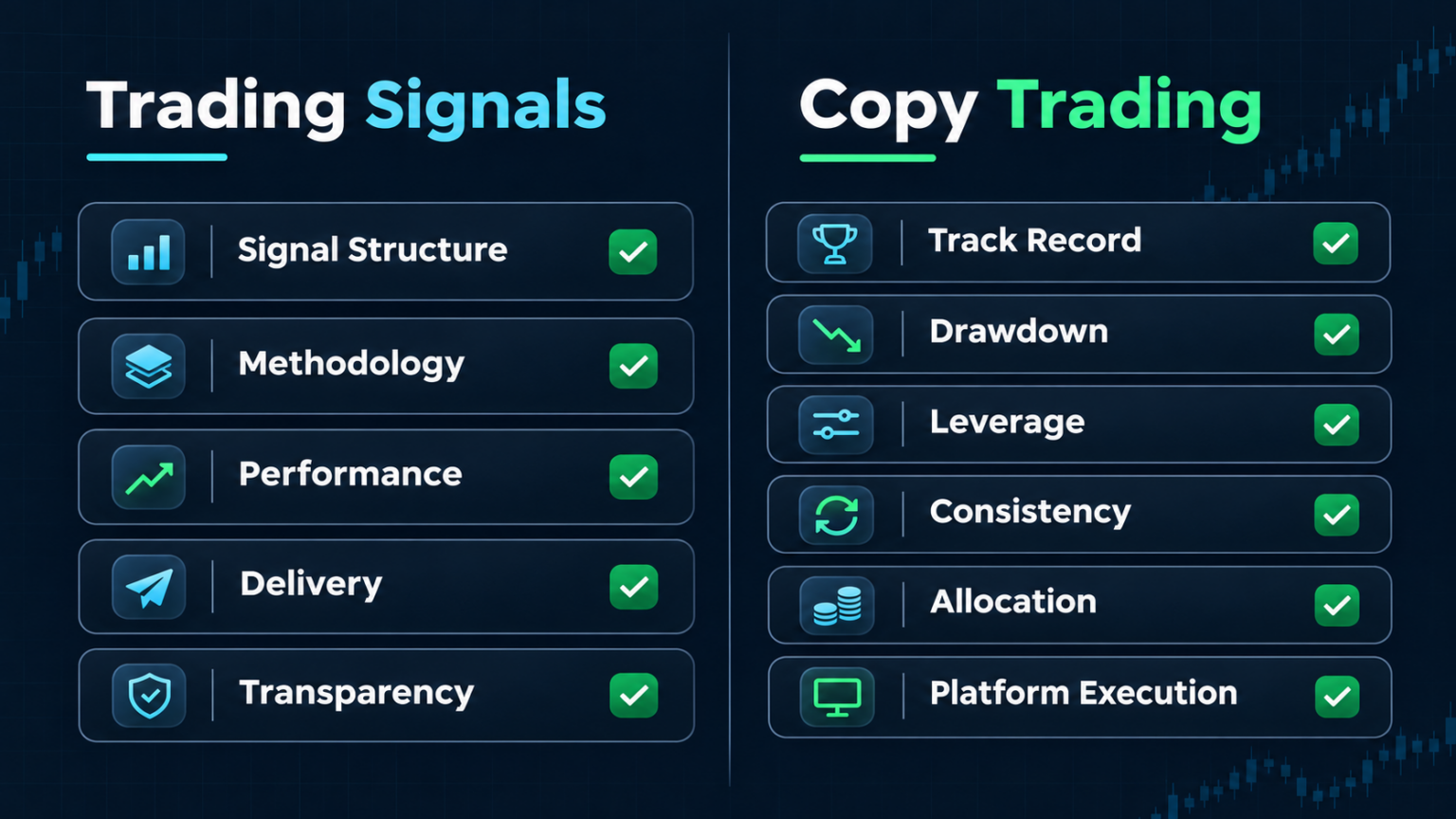
For trading signals, I would focus on signal structure, methodology, historical performance, win/loss economics, delivery speed, and transparency. The provider should show both winning and losing trades, and the methodology should make enough sense to understand what kind of opportunities the service is trying to identify. Delivery also matters because a strong short-term signal is not particularly useful if it consistently reaches you after the intended entry has passed.
Copy trading requires a slightly different review. A trader’s headline return matters, but so do the drawdown, leverage, consistency, trading frequency, and length of the track record behind it. A trader who has made 80% in a few months while tolerating enormous drawdowns may be less suitable than someone with slower but more controlled performance.
When evaluating a trader or strategy for copy trading, I’d look at track record, drawdown, leverage, consistency, strategy changes, allocation, and platform execution. I would also look at whether the trader’s recent results reflect how they normally trade. A sudden increase in leverage or a change in strategy can make an older track record much less relevant to what you are actually copying today.
5. Trading Signals or Copy Trading: Which Is Better for You?
Trading signals make more sense if you want to stay involved in individual trades. You can review each setup, control the entry and position size, and use the signal as another input alongside your own analysis. Copy trading suits traders who want less day-to-day involvement and are comfortable putting more responsibility on the trader or strategy they choose to follow. Neither option is inherently safer or more profitable. A weak signal process remains weak, and automatically copying a trader with poor risk management only automates the same problem.
So the choice mainly comes down to where you want the responsibility to sit. Trading signals give you more control over the gap between the trade idea and your account. Copy trading gives up some of that control in exchange for greater automation. The better option is the one whose level of control, involvement, and risk you can manage consistently.

Zeiierman
With over 16 years in the market, Zeiierman has extensive experience as a full-time trader and risk advisory consultant for hedge funds. He has developed many profitable trading strategies, drawing on his background in risk management and strategy execution.
More from Zeiierman