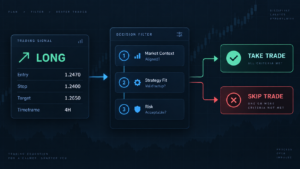
Of course they can, with conditions applied. The condition is simple: the underlying signal-providing process must be profitable in the first place.
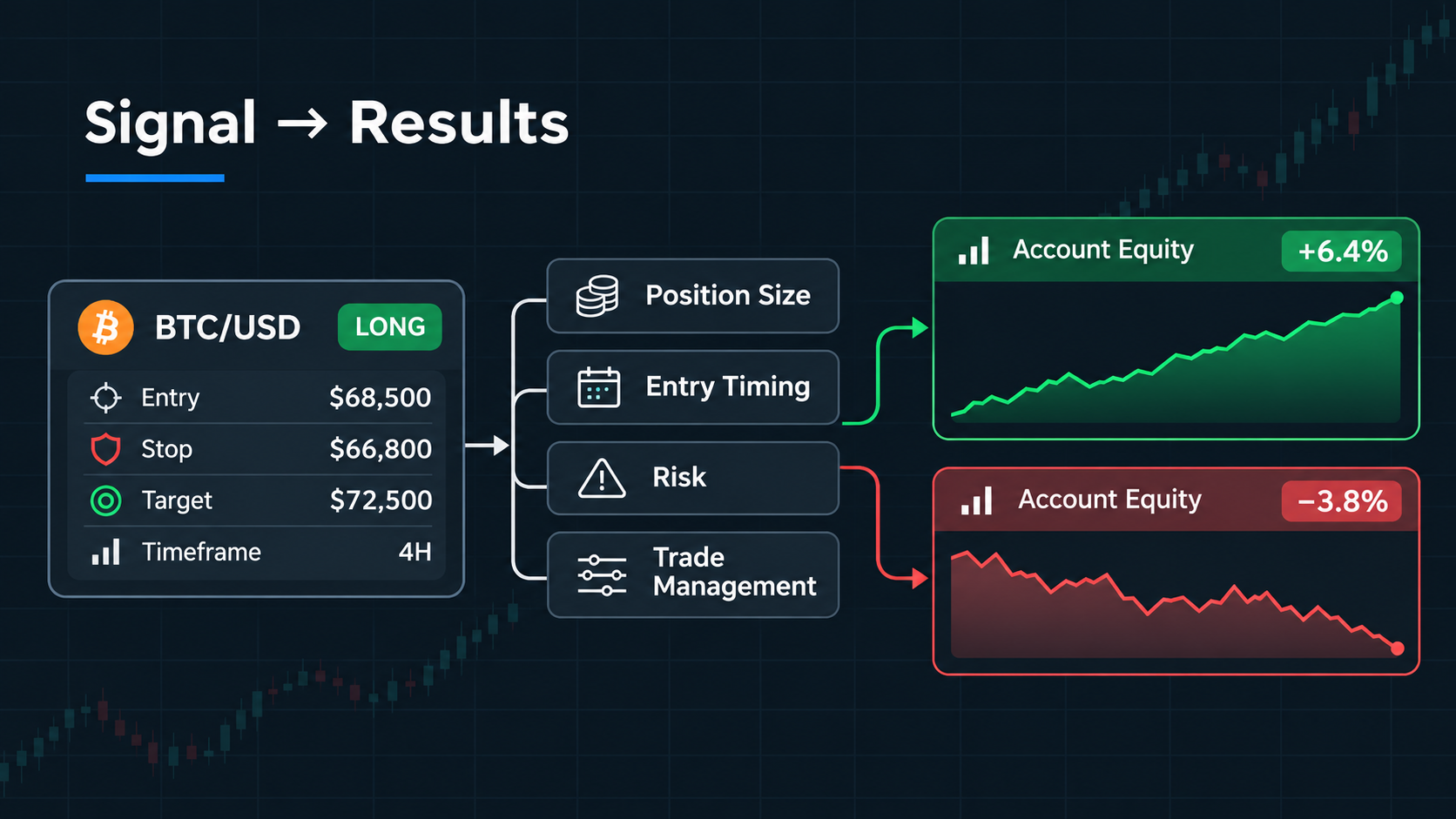
That said, a signal service’s performance can differ significantly from the trader’s performance. A provider might publish an entry, stop-loss, target, and timeframe, but the final outcome in your account still depends on how closely you execute that setup. Entering late, changing the position size, skipping trades, moving stops, or taking profits early can all change the economics of the original signal.
That is why I wouldn’t judge signal profitability by asking only whether a provider has a profitable track record. That is obviously important, but it is only the starting point. The more practical question is whether the signal can be executed consistently enough for the provider’s edge to carry through into your own results.
Let’s dig deeper into this.
1. Profitable Signals and a Profitable Trader Are Not the Same Thing
A signal provider usually measures performance according to a defined set of rules. If a signal says to enter at a certain price, place the stop at a specific level, and exit at a stated target, the reported result naturally reflects that structure. Your account result depends on what actually happens when you try to follow it.
Suppose a service produces five signals with results of +2R, -1R, +2R, -1R, and +2R. Taken as intended, that sequence finishes at +4R. Now suppose you miss the first winning trade, take both losses, enter the next winner late and make only +1R, then close the final winner early for +0.5R. The provider still has a +4R sequence, but your result is completely different.
That difference does not automatically mean the provider’s statistics are wrong. It means the signal passed through several additional decisions before reaching your account.
The first is execution. If you enter significantly later than the published price, the original reward-to-risk may no longer exist. The second is position sizing. Even identical trades will affect two accounts differently if one trader risks 0.5% per position and another risks 3%. Then there is trade management: moving the stop, taking partial profits, closing early, or holding beyond the original target can all change the result again.
Read: How to Evaluate a Trading Signal Provider Before You SubscribeSkipping trades matters as well. A strategy’s performance is calculated across a particular sample, and you don’t know beforehand which individual signals will produce the winners that make that sample profitable. By selectively choosing setups, you are effectively creating a different strategy.
It’s best to separate two important questions before you evaluate a signal’s money-making capabilities. First, does the signal process itself have a measurable edge? Second, can you follow that process closely enough for the edge to survive in your own account?
2. First, the Signals Themselves Need a Positive Edge
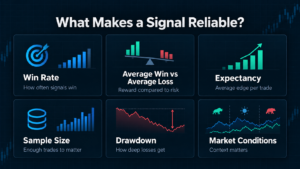
Don’t be too focused on win rate. A strategy winning 70% of its trades may sound attractive, but that figure only matters when you also know what happens on winning and losing trades. If the average loss is substantially larger than the average win, a high win rate can still produce a losing system. A simple way to think about this is through expectancy:
Expectancy = (Win Rate × Average Win) − (Loss Rate × Average Loss)
For example, suppose a signal strategy wins 50% of the time, averages 2R when it wins, and loses 1R when it fails. Its expectancy would be: (0.50 × 2R) − (0.50 × 1R) = +0.5R per trade
That does not mean each signal produces 0.5R. But it at least assures a positive average result across the measured sample data – which matters just as much as the headline number. Ten profitable signals tell you very little about how the strategy behaves over time. What you really want to know is whether that edge persists across a meaningful number of trades and, ideally, through different market conditions.
We covered the statistical side in much more detail in our guide to trading signal reliability, if you want to explore the numbers in more depth.
3. How Much You Risk Per Signal Changes Everything
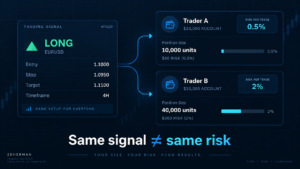
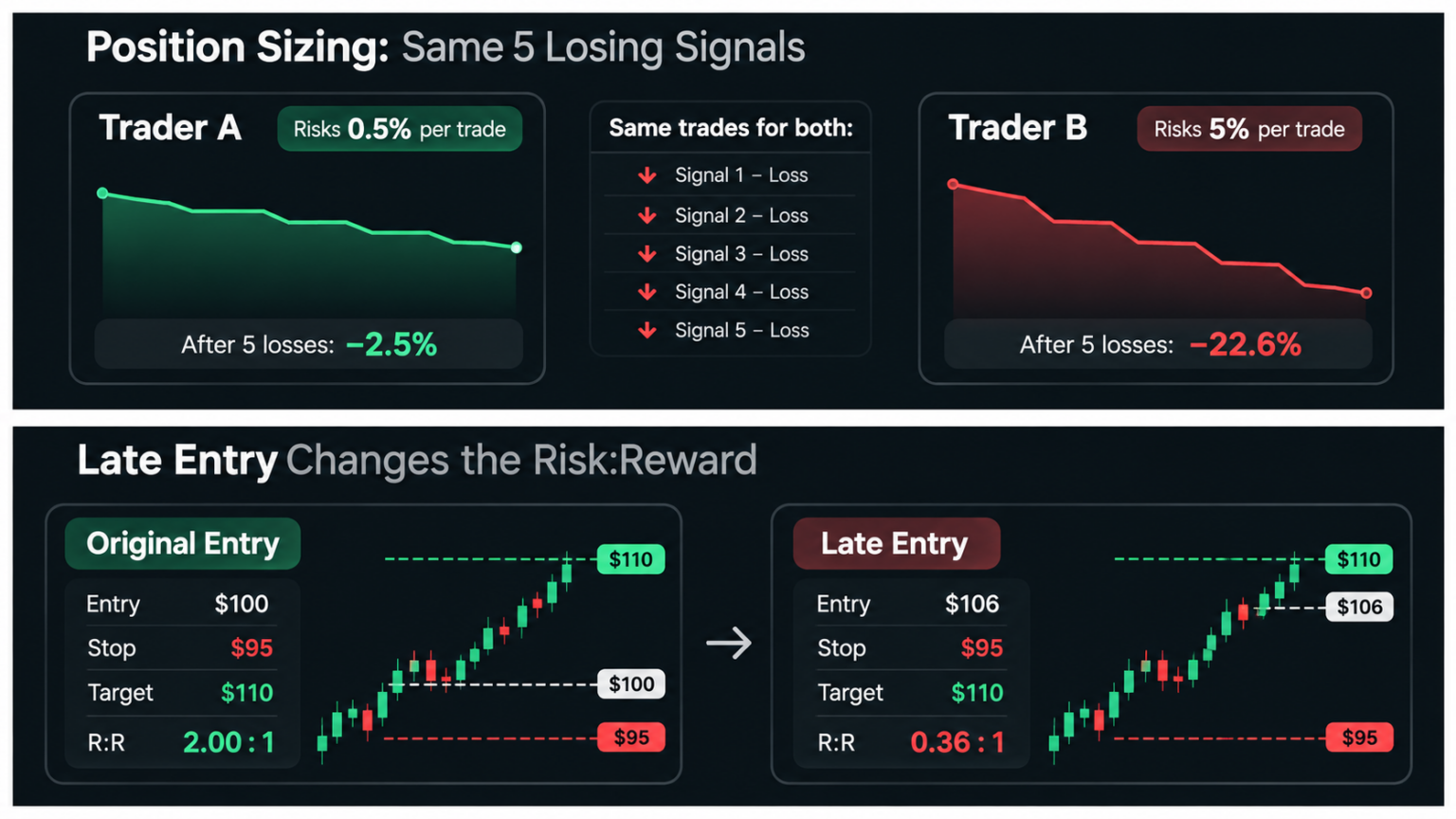
If the signal has a positive edge, the next biggest factor is position sizing. Suppose two traders follow the exact same signals but with different position sizes. Let’s ignore compounding for simplicity and assume Trader A is down roughly 2.5%, while Trader B is down roughly 25%.
That difference is not just psychological. It changes what the strategy needs to do to recover. A 25% drawdown requires a gain of roughly 33% to return to the starting balance, whereas a 2.5% drawdown requires only a small recovery. Aggressively sized trades are also difficult when trying to survive routine losing streaks in trading.
This is why increasing risk is not simply a case of taking the same strategy and making more money from it. Larger position sizes deepen drawdowns, increase account volatility, and make it much harder to stick with the process when losses arrive in clusters. A strategy can be profitable on paper and still become practically unusable if the trader risks too much on each signal.
Leverage creates the same problem. A signal may define a perfectly reasonable stop-loss, but excessive leverage can still make an ordinary losing trade disproportionately expensive. Correlated positions also deserve attention. If several signals express essentially the same market view, risking 1% on each trade does not necessarily mean your overall exposure is only 1%. A sharp move against that shared theme can affect several positions at once and turn what looked like a collection of small risks into one much larger account-level risk.
Read: How to Use Trading Signals Without Blindly Following Them4. Entry Timing Can Turn a Good Signal Into a Bad Trade
Even when the signal is strong and your position sizing is sensible, entry timing can materially change the trade you actually take.
Suppose a signal is published with an entry at $100, a stop-loss at $95, and a target at $110. At the intended entry, the trade risks $5 to make $10, giving you a 2:1 reward-to-risk ratio. Now imagine you see the signal late and enter at $106 while keeping the same stop and target. Your potential loss has increased to $11, while the remaining upside is only $4. The original 2:1 setup has effectively fallen to roughly 0.36:1.
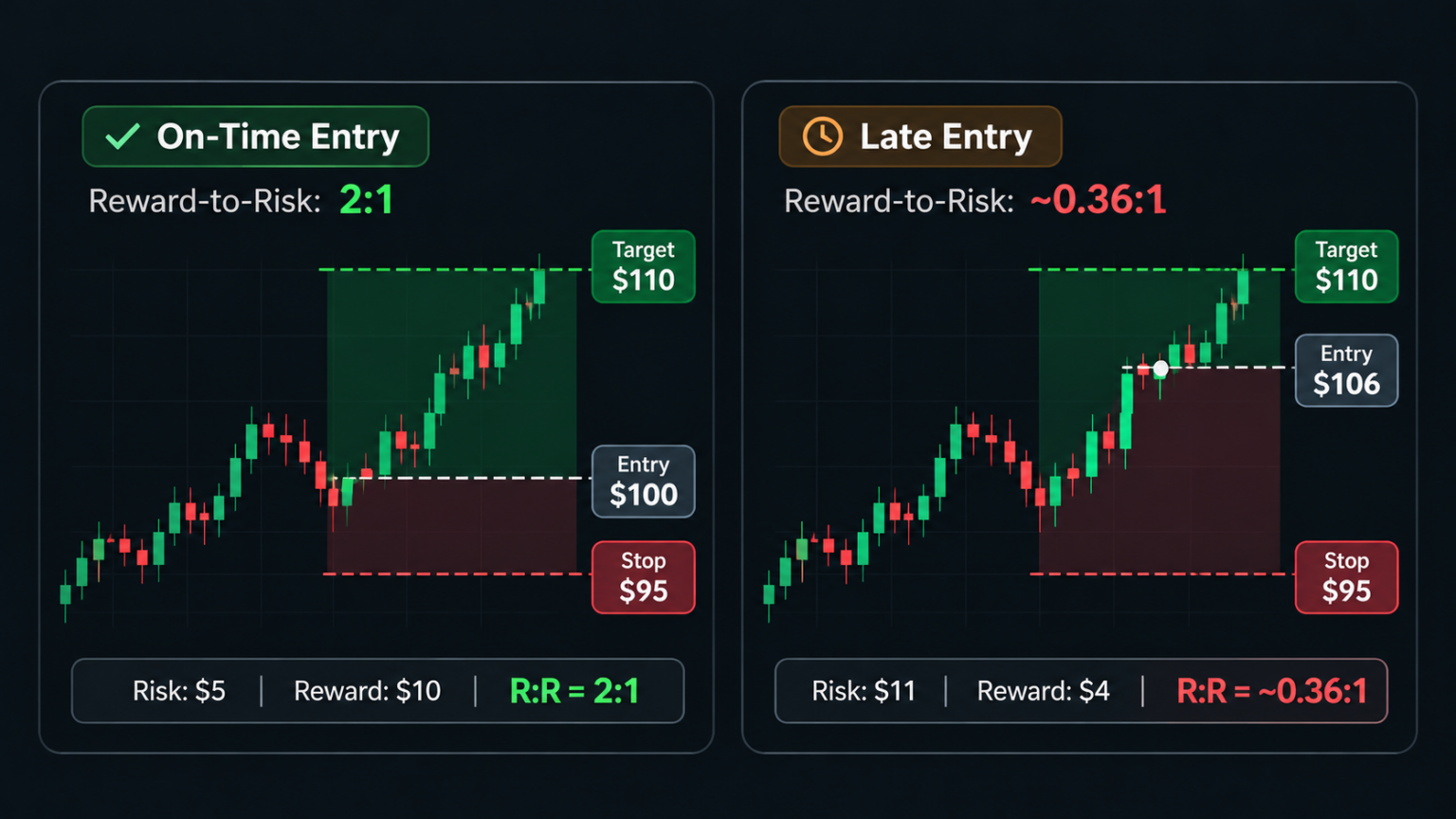
The market direction hasn’t changed, and the provider’s original signal may still be correct. But you are no longer taking the same trade. This is especially important in fast-moving markets, where price can move significantly between the signal being generated and your order being filled. Slippage, spread, and alert latency can further worsen the entry.
5. Trade Management Can Change the Provider’s Outcome Too
Even if you enter at the intended price and use sensible position sizing, the result can still change once the trade is open. A signal might define a stop-loss and a final target, but we often intervene before either level is reached. Some moves stop to break even quickly, take partial profits, close a trade early during a pullback, or hold past the original target in hopes of making more. Any of those decisions can alter the strategy’s expectancy.
Suppose a provider’s setup is designed to lose 1R when wrong and make 2R when right. If you repeatedly close winning trades at +0.5R because you are uncomfortable holding through normal price fluctuations, you may still record plenty of “wins,” but the payoff profile has changed significantly.
The opposite can happen as well. Moving a stop further away to avoid taking a loss may turn a planned -1R outcome into -2R or worse. Holding a trade past the stated target can occasionally produce a larger winner, but it can also give back profits the provider’s performance assumed would already be realized.
That does not mean discretionary trade management is always wrong. As an experienced trader, I often do this when dealing with trading signals myself. The important point is that once you start changing the management rules, you should no longer expect the provider’s historical results to apply exactly to your version of the trade.
6. So, Can You Actually Make Money With Trading Signals?
Yes, but only when several parts of the process line up.
The signals themselves need to have a genuine positive edge. Your position sizing has to be sustainable enough to survive normal losing streaks. Your entries need to stay reasonably close to the intended setup, and your trade management needs to be consistent enough that you aren’t constantly changing the payoff profile. On top of that, trading costs and subscription fees still have to leave enough of the edge intact to produce a worthwhile net result.
This is why I would avoid thinking about trading signals as a shortcut where someone else tells you what to buy, and profits simply follow. A better way to think about them is as structured trade opportunities that still need proper execution.
The provider can do a lot of the heavy lifting. They can scan markets, define the setup, establish the entry and invalidation, and provide a tested methodology. But they cannot control how much you risk, whether you chase a late entry, whether you skip trades after a losing streak, or whether you close winners too early.
That is ultimately why two traders can follow the same service and walk away with very different results.

SM_Trader
SM_Trader is a highly experienced coder and strategy developer who brings the most complex algorithms to life. As a member of MENSA, the prestigious organization for individuals with intelligence scores in the top 2% of the world, he combines exceptional analytical skills with a keen eye for numbers and statistics, empowering businesses to grow at the right pace and in the right direction.
More from SM_Trader