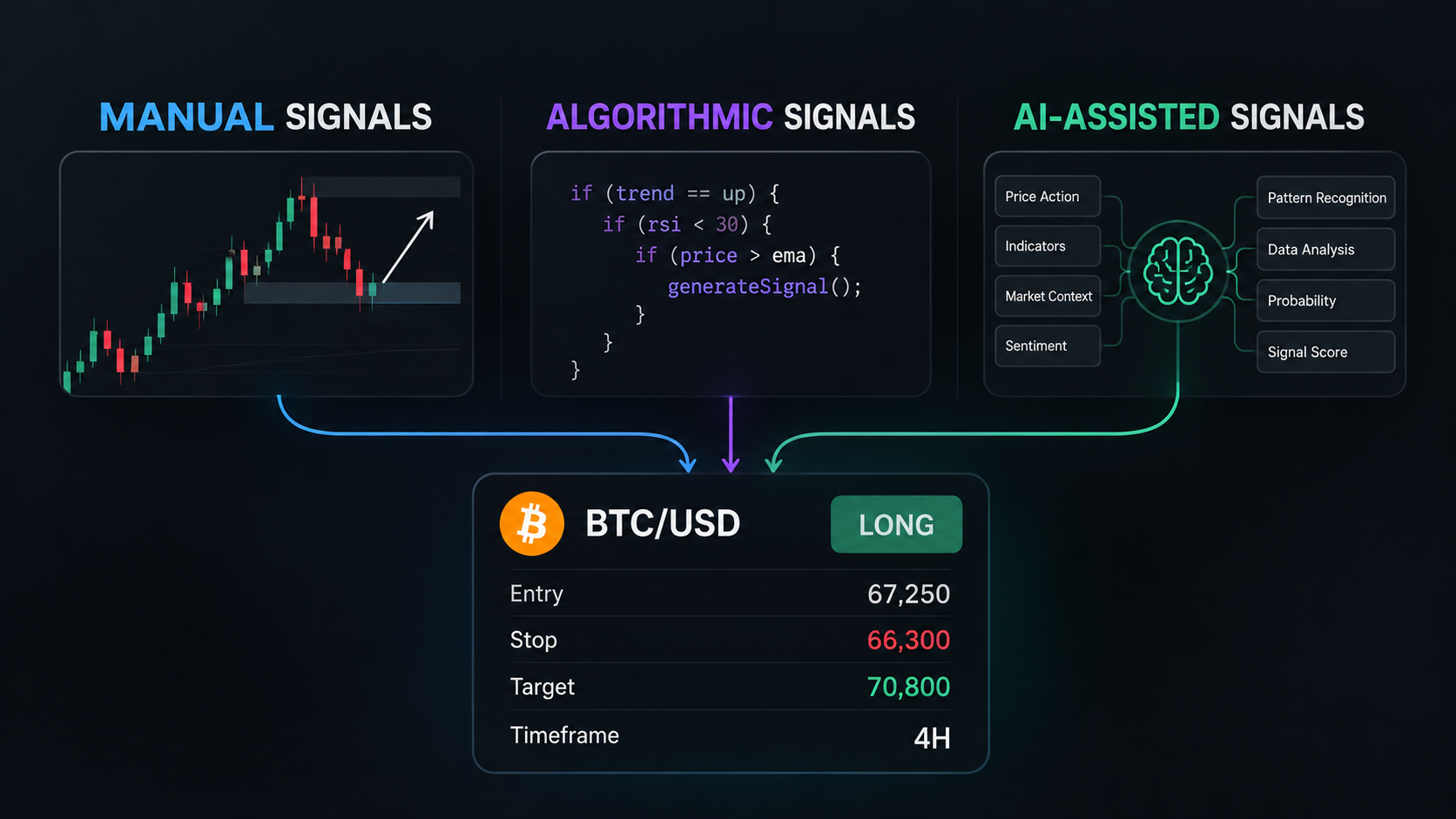
When a trading signal appears on your screen, you are only seeing the final output. A message might tell you to look at BTC/USD, give you an entry zone, stop-loss, targets, and timeframe, but none of that explains how the opportunity was found in the first place.
That process can vary considerably between providers. One service might rely on a trader to manually review charts and publish setups. Another might use indicators or predefined rules to generate alerts automatically. Larger systems can scan many markets and timeframes continuously, while AI may classify conditions, rank setups, or filter alerts before sending them.
These methods are often marketed as though one is inherently more advanced than another. In reality, the technology matters less than what the process is designed to detect and how consistent it is. So rather than asking whether manual, algorithmic, or AI-generated signals are “best,” it is more useful to understand how each method turns market information into a trade idea and where its strengths and limitations come from.
1. The Basic Signal-Generation Process
Most trading signals follow roughly the same path:
Market data → Analysis or conditions → Setup detected → Filtering → Signal created → Delivery
The process begins with data. Price is the obvious input, but a strategy may also consider volume, volatility, technical indicators, market structure, liquidity, multiple timeframes, or even fundamental and event data, depending on how the system is built.
From there, the methodology decides what it looks for. A breakout strategy might monitor whether price clears a defined resistance level. A momentum system could require trend alignment alongside increasing strength. A more complex model may evaluate several conditions together before it considers a setup valid.
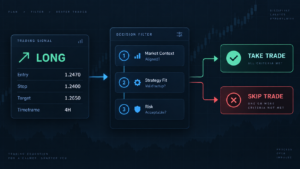
Once a potential setup is detected, the next step is filtering. A system may reject an otherwise valid setup because the reward-to-risk is poor, volatility is unsuitable, a higher timeframe conflicts with the trade, or similar exposure already exists elsewhere.
Only after those checks does the opportunity become the structured signal the trader eventually sees. The final step is delivery through whatever channel the provider uses, such as an app, Discord, Telegram, email, or dashboard. This distinction between detecting setups and delivering signals matters. A scanner might identify hundreds of potential opportunities during the day while only a small fraction survive the provider’s filters.
That means a signal-generation system’s quality isn’t determined only by how well it finds trades. It also depends on what it chooses not to send.
Read: Trading Signals Explained: What They Are & How They Work2. Manual Trading Signals
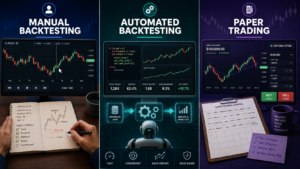
Manual trading signals come from a trader or analyst who reviews the market, identifies a setup, defines the trade, and then publishes it for others to evaluate.
This approach works best when the strategy depends on context that is hard to reduce to a simple rule. A discretionary trader may consider market structure, support and resistance, liquidity, momentum, volatility, and the quality of a particular setup before deciding whether it is worth taking.
That flexibility is the main advantage. A human analyst can adapt when conditions change, ignore a technically valid setup that looks weak in context, or account for unusual market behavior that a rigid system may not handle well. The trade-off is consistency and scale.
A person can only monitor so many markets and timeframes at once. Manual analysis can also be subjective, which means two experienced traders may look at the same chart and reach different conclusions. Even the same analyst may interpret similar setups slightly differently from one day to the next.
3. Indicator and Rule-Based Trading Signals
Rule-based signals take a different approach. Instead of relying on a trader to decide whether a setup qualifies, the conditions are defined in advance. A simple system might say: Generate a long signal when the 20-period moving average crosses above the 50-period moving average and RSI is above 50.
Once those conditions are met, the system can automatically generate the alert. You can build rules around almost any measurable input: moving averages, RSI, MACD, breakouts, volatility, volume, support and resistance logic, or custom indicators. More complex systems may require several conditions to align before triggering anything.
The biggest advantage is consistency. The same market condition is evaluated using the same rules every time, which makes the process easier to automate, test, and compare over larger samples.
The limitation is that rules only understand what you program into them. A setup may technically meet every condition while still appearing poor in the broader market context. Simple systems can also generate a lot of noise if the filters are too loose or market conditions change.
This is why I would separate a basic indicator alert from a complete trading signal. An indicator can tell you that a condition occurred. A proper signal should usually add enough structure around that event to make the opportunity actionable.
Read: What Traders Get Wrong About “High-Probability” Signals4. Algorithmic Trading Signals
Algorithmic signal systems take rule-based trading a step further by combining multiple conditions, filters, and markets into a process that can run continuously.
Instead of waiting for one indicator to trigger, an algorithm might scan dozens or hundreds of instruments across several timeframes and evaluate several variables at once. That could include trend direction, volatility, momentum, liquidity, market structure, and reward-to-risk before a setup is considered strong enough to send.
A typical process can look like this: Scan markets → Detect qualifying setups → Apply filters → Rank opportunities → Generate signals
The main advantage is scale. A trader can only watch a limited number of charts closely, while software can keep monitoring large numbers of markets without getting tired or distracted. It also applies the same logic every time, which helps reduce the inconsistency that can creep into discretionary decision-making.
But automation does not automatically make a strategy better. An algorithm is only as useful as the logic behind it. If the rules are weak, over-optimized for historical data, or poorly suited to changing market conditions, the system can simply produce bad signals more efficiently.
5. How AI Can Be Used to Generate Trading Signals
“AI-generated trading signals” can mean several different things, so the label alone doesn’t tell you much about how the system actually works. In some systems, AI may classify the current market environment. A model could help determine whether conditions are trending, ranging, volatile, or unusually quiet before deciding which types of setups deserve more attention.
In others, AI may rank or filter setups already detected by conventional rules. For example, an algorithm might find 50 potential trades, while an AI model helps estimate which ones most closely match historically stronger conditions. AI can also interpret charts, recognize patterns, combine large numbers of variables, or summarize market context before sending a signal.
This creates an important difference between an AI-generated signal and an AI-assisted signal. Neither approach is automatically superior. AI still depends on the quality of its inputs, the way it has been trained or configured, and the market conditions it encounters. It can still overfit, misclassify conditions, or perform poorly when the environment changes.
6. Hybrid Signal Systems
In practice, many signal providers, including us at Zeiierman Trading, do not rely on a single generation method. We combine human judgment, indicators, algorithms, and sometimes AI into a hybrid system.
One common setup is algorithm first, human review second. Software scans the market continuously and flags potential setups, then a trader reviews the strongest candidates before publishing anything. This keeps automation’s speed and coverage while adding a discretionary check before delivery.
Another approach is to use a rule-based or algorithmic system for detection and then apply an additional model for filtering or ranking. For example: Algorithm detects setup → AI or secondary model ranks it → Signal is generated only if it passes the final filter
The reverse can also happen. A trader may identify the broader market bias manually while software handles the actual entry conditions, stop placement, or alert delivery. This is often more practical than trying to make one method do everything. However, the downside is complexity. The more layers a system has, the harder it becomes to understand which part is actually contributing value.
So with hybrid systems, the key question isn’t simply how many technologies are involved. It is whether each layer has a clear purpose and improves the final decision-making process.
7. Filtering Is Often More Important Than Signal Generation
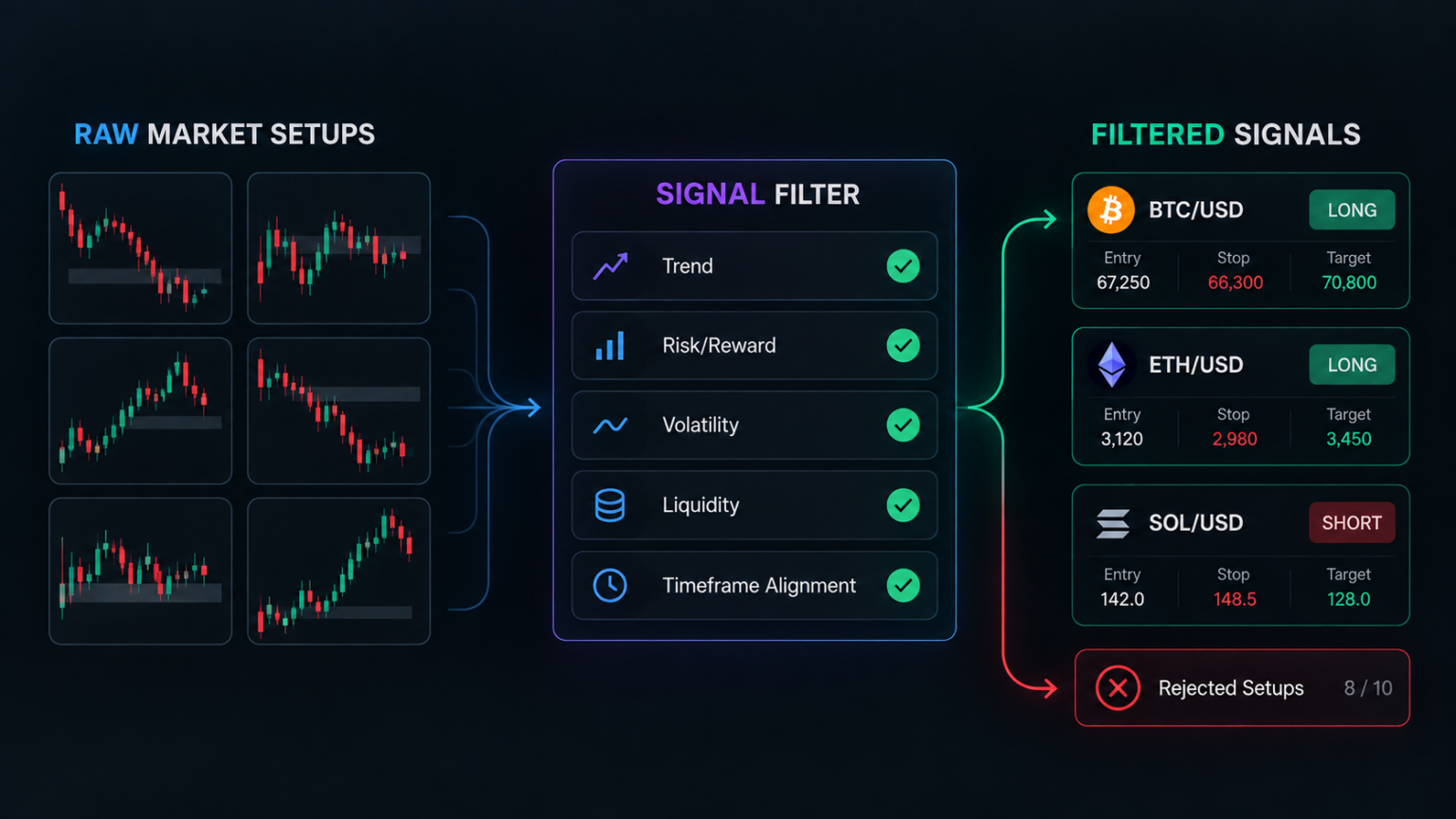
A scanner can easily identify dozens or even hundreds of situations where predefined conditions are technically met. The real challenge is deciding which of those opportunities are actually worth sending.
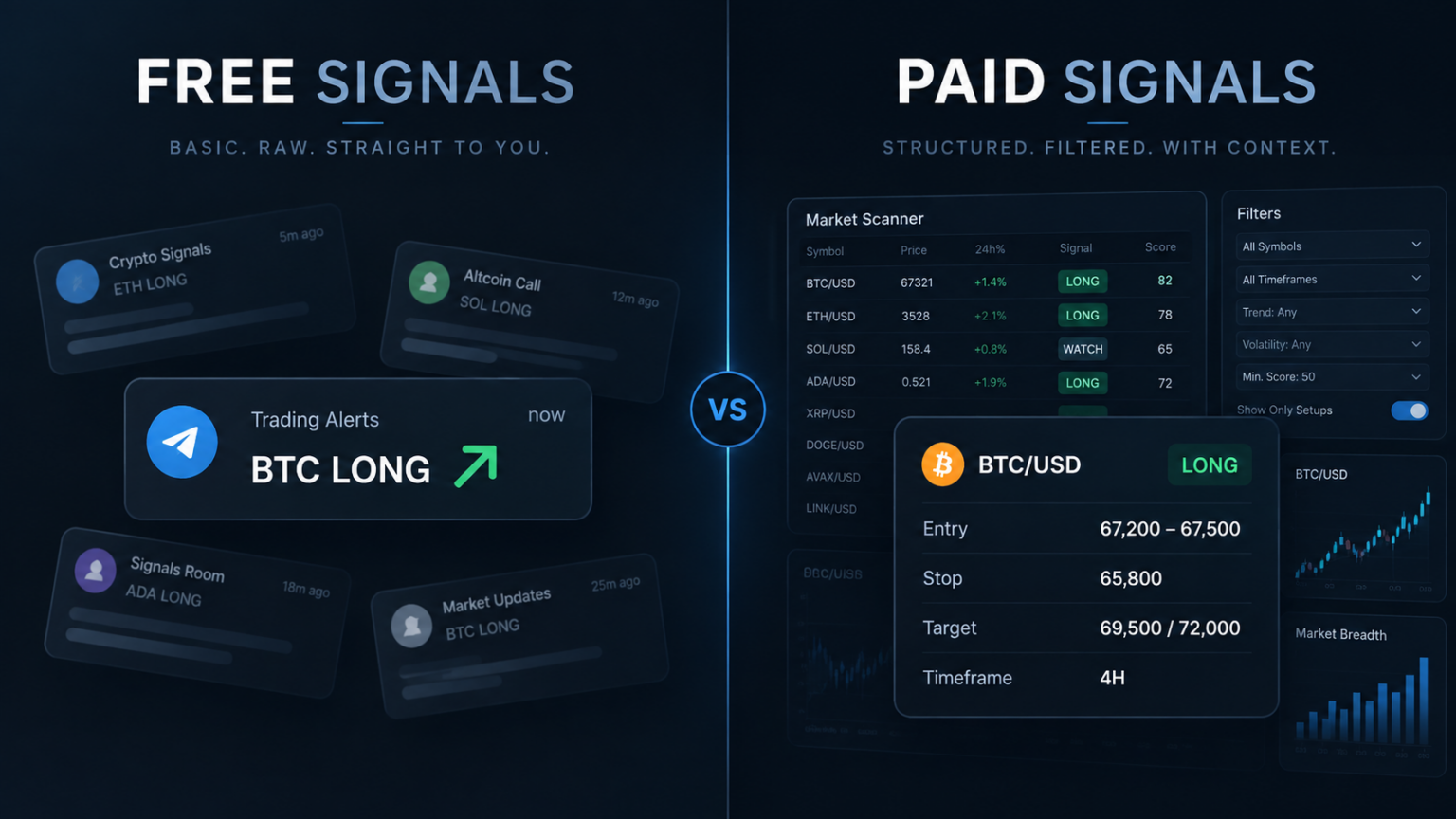
Read: Free vs Paid Trading Signals: What Are You Actually Paying For?Imagine a system detects 100 possible setups during a trading session. Some might occur against the higher-timeframe trend. Others may offer poor reward-to-risk, appear in illiquid markets, trigger during unusually high volatility, or create too much correlated exposure with existing trades.
Once you filter out those conditions, perhaps only a small portion of the original setups remain. That filtering process can include factors such as trend alignment, volatility, liquidity, reward-to-risk, market regime, timeframe confirmation, or whether similar positions are already open. For traders, that distinction matters because more signals are not necessarily better. A service that sends fewer, more selective setups may do significantly more work behind the scenes than one that simply forwards every alert an indicator generates.
8. How Should Traders Evaluate a Signal-Generation Method?
No single generation method is automatically better than the others. A skilled discretionary trader can produce excellent manual signals. A simple rule-based system can work well if the logic is robust. An algorithmic scanner can add scale and consistency, while AI can improve classification or filtering when it is used properly.
| Method | Main Strength | Main Limitation | Best Suited For |
|---|---|---|---|
| Manual | Context and discretion | Limited scale and subjectivity | Context-heavy setups |
| Rule-based | Consistency and repeatability | Can be rigid or noisy | Clearly defined strategies |
| Algorithmic | Speed, scale, and multi-market coverage | Depends heavily on coded logic | Large-scale market scanning |
| AI-assisted | Classification, ranking, and filtering | Complexity and overfitting risk | Enhancing existing signal systems |
| Hybrid | Combines strengths of multiple methods | More complex to evaluate | Structured multi-layer signal services |
What matters more is whether the process itself holds up under scrutiny. I would look at questions such as:
- Is the methodology repeatable?
- Can the provider explain, at least broadly, what conditions generate a signal?
- Has the process been tested across a meaningful sample?
- How do you filter out weak or conflicting setups?
- Does the system behave differently in trending, ranging, or volatile markets?
- Is risk defined as part of the signal?
- Are losing trades recorded as transparently as winning ones?
A provider may use sophisticated software and still have weak logic underneath it. Another may use a relatively simple rules-based system but apply those rules consistently and manage risk well. The generation method matters, but I would judge it mainly by whether it produces repeatable, understandable, and testable decisions over time.

SM_Trader
SM_Trader is a highly experienced coder and strategy developer who brings the most complex algorithms to life. As a member of MENSA, the prestigious organization for individuals with intelligence scores in the top 2% of the world, he combines exceptional analytical skills with a keen eye for numbers and statistics, empowering businesses to grow at the right pace and in the right direction.
More from SM_Trader