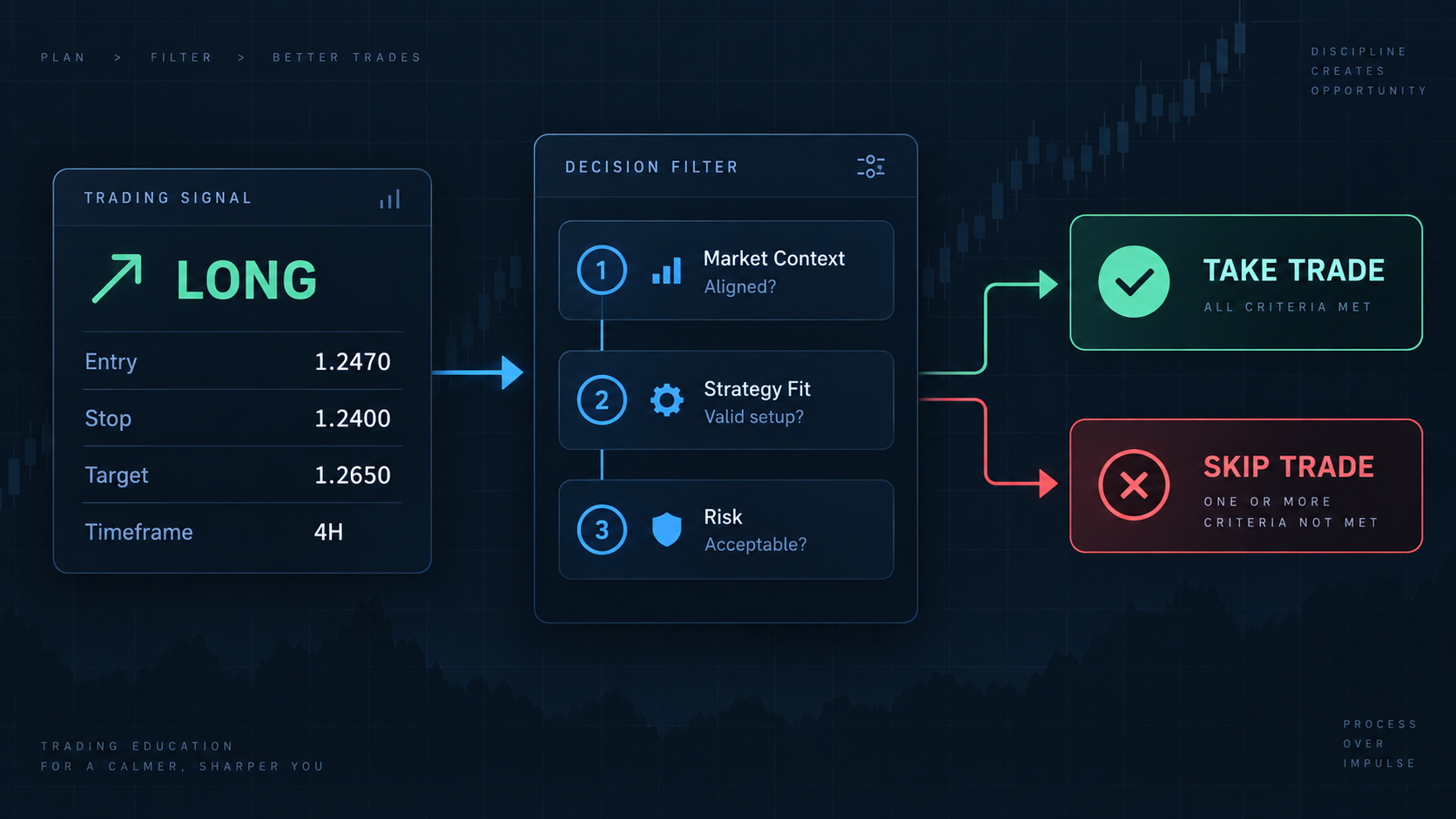
The most useful way to think about a trading signal is as an input to your decision-making process, not a command to place a trade. The signal provider doesn’t know your account size, how much risk you already have open, which markets you trade best, whether you are already exposed to a correlated position, or how comfortable you are holding through volatility.
Two traders can receive the same signal and reasonably make different decisions. That does not mean the signal is bad. It means the trader still makes the final decision.
This is where people get into trouble with signal services. Beginners often stop evaluating trades on their own merits once they start treating every alert as something they are supposed to copy. You are effectively handing over your risk decisions to someone who does not know your portfolio or your trading plan.
I would rather use signals to reduce the amount of scanning I need to do, surface setups I might have missed, and give me another perspective on the market. From there, I still want to decide whether the trade makes sense for me.
1. Understand What the Signal Is Actually Telling You
At a minimum, I would want to know the market, trade direction, entry or entry zone, stop-loss, targets, and timeframe. Depending on the service, you may also get an expiry, invalidation condition, or some explanation of the setup.
An entry tells you where the idea becomes actionable. The stop tells you where the setup is considered wrong. The target tells you what the trade is trying to capture. The timeframe gives you context for how quickly the setup is expected to develop and how much noise you should reasonably expect along the way.
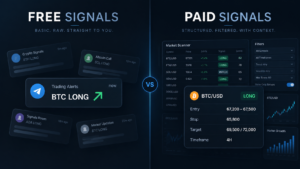
Take a simple alert that says: BTC Long
That tells you almost nothing about the actual trade. Are you entering immediately? On a pullback? Is the stop 0.5% away or 8% away? Is this a five-minute scalp or a swing trade expected to run for several days?
Now compare that with a structured signal that gives you a clear entry zone, invalidation level, targets, and timeframe. Even if you decide not to take it, you can at least assess whether the idea makes sense.
One rule I would keep simple is this: “If you cannot explain what would invalidate the trade, you probably do not understand the signal well enough to follow it.”
That’s not to say you MUST agree with every part of the analysis, but you should understand the trade’s logic before putting money behind it.
Read: Build Your First Trading Bot: A Simple TradingView Breakout Bot from Setup to Live Alerts2. Check the Signal Against the Current Market Context
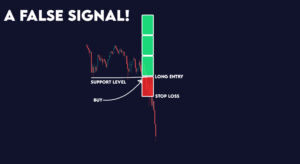
A signal can be valid when it is generated and still become a poor trade by the time you see it. Markets move quickly, especially on lower timeframes. If the original entry was based on a specific level, breakout, pullback, or liquidity event, then the context may change significantly after the alert is sent.
Your upside may be smaller, your downside may be larger, and the original reward-to-risk can disappear entirely. That is why I would always compare the signal with the current chart before doing anything.
Look at the broader trend, nearby support and resistance, volatility, and whether price is still trading around the intended entry. If the setup was based on a specific market condition, check whether that condition is still present.
You should also be aware of obvious event risk where relevant. A technically clean setup can behave very differently around major economic releases, earnings, or other events that materially change volatility.
3. Decide Whether the Setup Fits Your Own Strategy
A trading signal can be technically valid but still a poor fit for how you trade. If your process is built around higher-timeframe trend trades, a five-minute mean-reversion signal may not belong in your account. Likewise, if you normally avoid holding through major news or overnight sessions, a signal that requires exactly that may not fit your process.
Before taking a trade, check whether it matches the markets, timeframes, setup types, and conditions you already understand. If you usually trade pullbacks in established trends, for example, there is little reason to start taking countertrend scalps simply because an alert appeared.
This matters even more when you follow several signal sources. Without your own filter, you can end up trading a mixture of unrelated strategies with different assumptions and risk profiles. At that point, it becomes difficult to tell what is actually working.
I would rather use signals to surface opportunities that fit an existing process than use them to constantly introduce new ones.
4. Recalculate the Risk Before Entering
Never copy someone else’s position size along with the signal. The provider may define the setup, but you still decide how much of your account is exposed to it.
Before entering, look at the distance between the entry and stop, decide how much capital you are willing to risk, and size the position accordingly. The same signal can represent 0.5% account risk for one trader and 3% for another depending on how they size it.
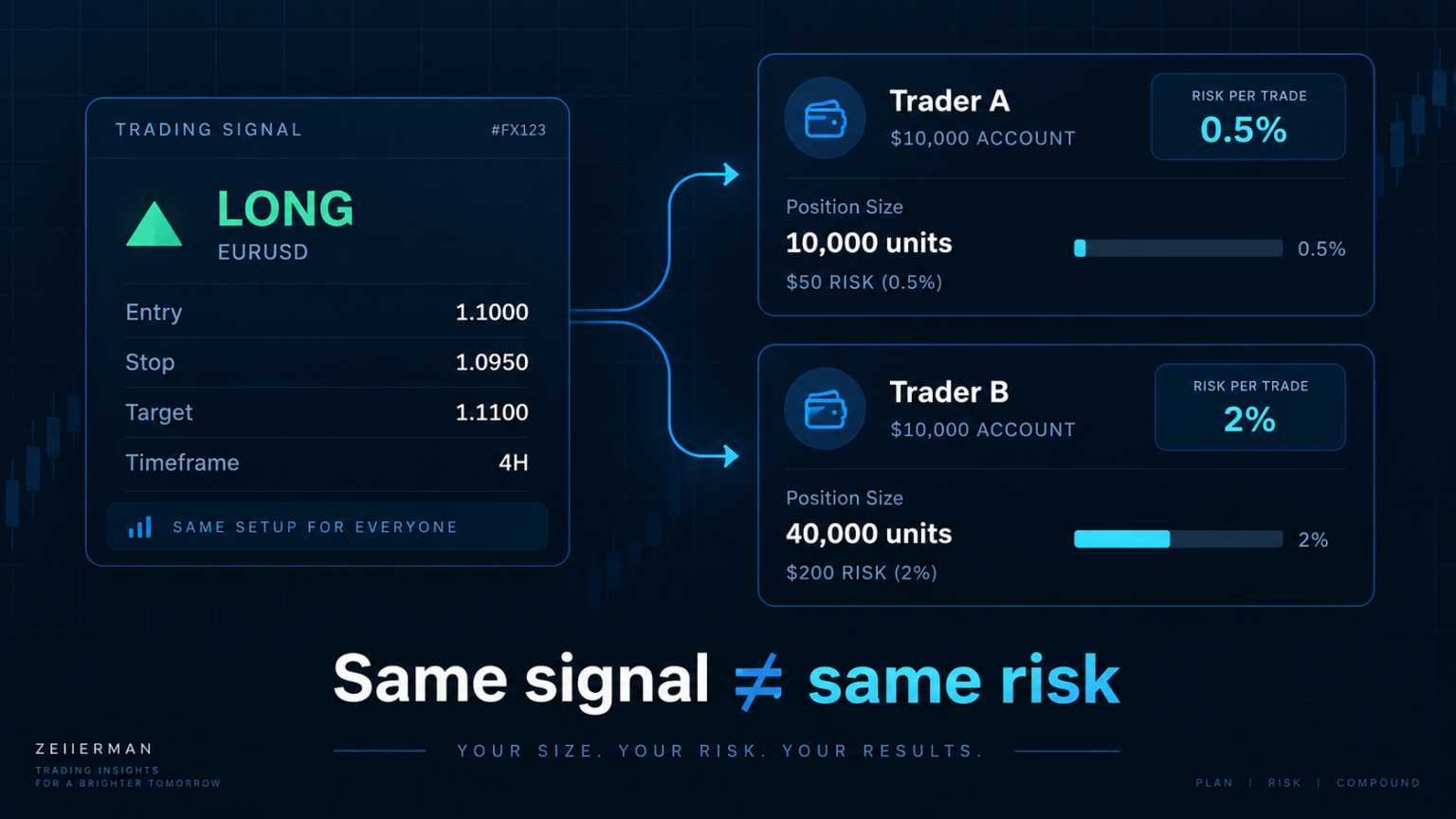
You should also look beyond the individual trade. Suppose you already have two long crypto positions open and receive another bullish signal on a highly correlated asset. Taken separately, each trade may look reasonable. Taken together, they could leave you far more exposed to one market move than you intended.
The same applies across indices, currencies, sectors, or any group of instruments that can move together. This is why I would separate signal quality from risk allocation. A strong setup does not justify oversized risk, and a high-probability label does not make the stop optional.
5. Don’t Chase a Signal After the Entry Has Passed
Timing matters because the trade you receive and the trade you actually enter may not be the same. Suppose a signal gives you:
- Entry: 100
- Stop: 95
- Target: 110
At the original entry, you are risking 5 points to potentially make 10. If you see the alert late and enter at 106 instead, the structure changes completely. You now have much less upside to the same target while taking considerably more downside to the original stop.
Read: A Beginner’s Guide to Structured Trade Signals on SwipeXThe signal itself may still be directionally correct, but the reward-to-risk you were shown no longer exists. This is why entry zones, expiry, and invalidation matter. If price has moved too far from the intended area, don’t assume you need to get into the trade just because the alert is still on your screen.
Sometimes the correct response to a good signal is to do nothing. If the market pulls back into a valid entry again, you can reassess it. If it does not, there will be another setup.
📌 Editor’s Note: Missing a trade is usually less damaging than forcing your way into one after its original structure has disappeared.
6. Track the Signals You Actually Take
If you use trading signals regularly, record what happens after you receive them. Otherwise, it becomes surprisingly easy to judge the service from memory.
At minimum, I would track the signal, your actual entry, stop, target, position size, result, and whether you followed the original setup or changed something along the way. Also note why you accepted or rejected a trade when the decision wasn’t obvious.
That helps separate two different questions: Is the signal source useful? and Am I using the signals well?
A provider may send a reasonable setup, but you enter late, move the stop, or take profit too early. In that case, your result says as much about your execution as it does about the signal. The opposite can happen too: you may manage a mediocre signal well and still come away with a decent outcome.
Over a larger sample, the record becomes much more useful. You can see which markets you handle best, whether chasing entries hurts results, whether certain signal types suit you better, and whether your adjustments help or make things worse.
7. When You Should Ignore a Trading Signal
I would usually skip a signal when the original entry has passed, the reward-to-risk no longer makes sense, the setup conflicts with my strategy, or I cannot clearly identify where the trade becomes invalid. The same applies if the trade would leave me overexposed to a correlated market or if I simply do not understand the setup.
A signal can be perfectly reasonable when sent and stale a few minutes later. If the reasoning is unclear or the market has changed materially since the alert was generated, sitting out is a valid decision.
8. How I Would Use Trading Signals in Practice
If I were using a signal service regularly, I would keep the process simple. First, I would use the signal to surface the opportunity. That saves me from scanning every market manually and gives me a starting point. From there, I would check whether the setup is still valid, whether it fits my trading style, and whether the risk still makes sense at the current price.
Then I would size the trade based on my own account and exposure rather than copying someone else’s position size. If the entry has already moved too far, the reward-to-risk has deteriorated, or I already have too much exposure to the same market theme, I would skip it.
Once I take the trade, I would record what I actually did. That makes it easier to separate signal quality from execution quality later. So the workflow is straightforward:
Receive signal → Understand the setup → Check current market conditions → Check strategy fit → Recalculate risk → Decide → Record the outcome
That is how I think signals are most useful. They can reduce scanning time, surface ideas you might have missed, and give you another view of the market without forcing you to outsource the final decision.

Zeiierman
With over 16 years in the market, Zeiierman has extensive experience as a full-time trader and risk advisory consultant for hedge funds. He has developed many profitable trading strategies, drawing on his background in risk management and strategy execution.
More from Zeiierman