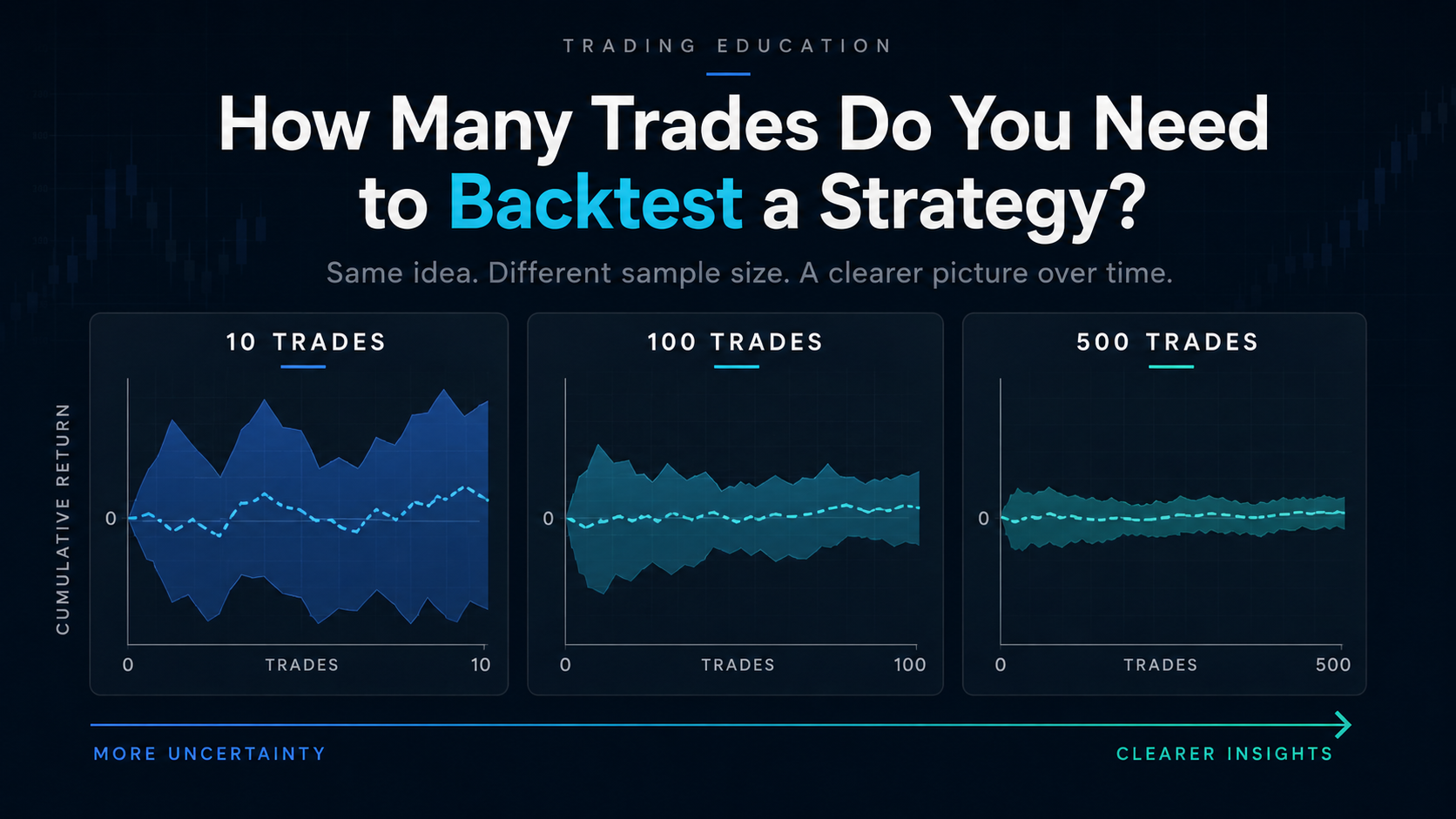
You will hear all sorts of numbers thrown around in trading. 30 trades. 50 trades. 100 trades. 500 trades.
The problem is that none of those numbers magically turn an unreliable backtest into a reliable one. There isn’t a universal minimum number of trades that proves a strategy works. The amount of testing you need depends on what you are actually trying to learn from the backtest, how variable the strategy’s results are, the market conditions included in the sample, and how many versions of the strategy you tested before settling on the current one.
This distinction matters because trade count and evidence are not the same thing.
You could have 200 breakout trades taken during one unusually strong bull market. On paper, that looks like a decent sample. But those trades may all be telling you roughly the same thing: how the strategy behaves during one favorable environment. Compare that with a smaller sample containing trends, ranges, volatile periods, quiet markets, and both winning and losing years. The second sample may tell you much more about how robust the strategy actually is.
That said, we still need practical checkpoints. I would treat 100 trades as a useful point where a backtest starts becoming more interesting – not as a point where the strategy suddenly becomes trustworthy.
Below that, random streaks can dominate the results surprisingly easily. Above it, your estimates generally become more stable, but the quality and diversity of those trades still matter enormously.
So instead of asking whether you have tested enough trades, ask yourself this: “Have I collected enough independent and varied evidence to understand how this strategy behaves?” That is a much harder question, but it is also the one worth answering.
1. Why Traders Keep Hearing “Backtest at Least 100 Trades”
There is some statistical logic behind the popularity of the 100-trade rule. Imagine a very simplified strategy where every trade has only two outcomes: win or loss. For the moment, assume:
- Every trade is independent
- The underlying win probability stays constant
- The true win rate is somewhere around 50%
Under those assumptions, the uncertainty around your observed win rate shrinks as the sample gets larger.
| Trades Tested | Approx. 95% Uncertainty Around Win Rate |
|---|---|
| 25 | ±20 percentage points |
| 50 | ±14 points |
| 100 | ±10 points |
| 200 | ±7 points |
| 400 | ±5 points |
This helps explain why a strategy that goes 15-for-25 should not excite you nearly as much as seeing similar performance across several hundred trades. Suppose your strategy wins 60 out of 100 trades. It is tempting to write down your win rate at 60%.
But 100 trades still leave substantial statistical uncertainty. The underlying win probability could be meaningfully different from the 60% you happened to observe in that particular sample. This is why 100 trades is a useful checkpoint. Compared with 20 or 30 trades, random winning and losing streaks have less influence over the headline result.
A trading strategy, however, is not simply a sequence of identical coin flips. Trades can (and do) have different winner and loser sizes, changing volatility, different market regimes, transaction costs, skewed outcomes, correlation with earlier trades, and occasional unusually large winners or losers
Read: Manual Backtesting vs Automated Backtesting vs Paper TradingAnd win rate may not even be the statistic you care about most. A 40% win-rate strategy with large winners can outperform a 65% win-rate strategy whose losses overwhelm its gains.
The next question is what, exactly, you’re trying to estimate from those trades.
2. The Actual Number Depends on What You’re Trying to Learn
Another reason there is no magic number for backtesting is that different performance measures require varying amounts of data to be reliable. If you are mainly estimating win rate, you need enough trades for a few lucky or unlucky streaks to stop dominating the percentage.
That is the problem we looked at in the previous section.
But suppose you care about expectancy or average R. Now the size of each winner and loser matters too. A strategy that produces lots of -1R losses and occasionally catches a +8R or +10R winner may need substantially more trades before its average result starts settling down. One unusually large winner can distort a small sample.
Drawdown is harder again. You can backtest 100 trades without ever encountering the kind of losing sequence the strategy will eventually experience. The absence of a deep drawdown in your sample does not mean the strategy cannot produce one.
Then there is market-regime robustness. Fifty trades from a strong trend tell you little about how the same strategy behaves in a range, a volatility spike, or a prolonged bearish market.
So instead of asking about the number of trades. Ask yourself how many trades you need to estimate what you’re trying to figure out. Win rate, expectancy, drawdown, and robustness do not necessarily become reliable at the same speed.
3. 200 Trades From One Market Regime May Still Be a Weak Backtest
Imagine you backtest 200 long breakout trades during a powerful bull market. Your sample size is now respectable on paper. But how much independent information did those 200 trades really give you?
They may all share broadly similar trend conditions, volatility, liquidity, directional bias, and the macro environment. If the market environment itself strongly favored long breakouts, adding another trade from essentially the same regime may tell you less than the raw trade count suggests.
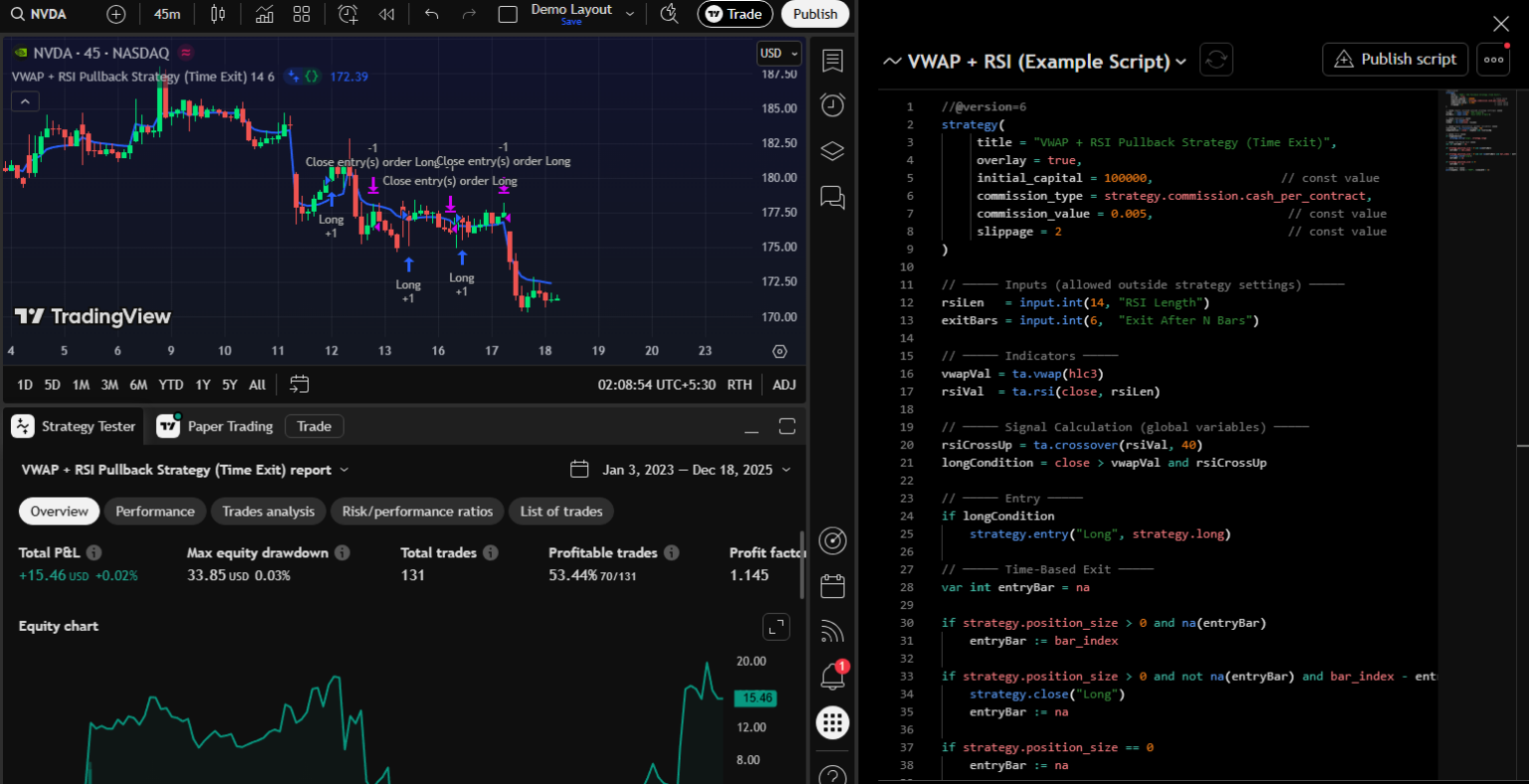
Now compare that with a sample containing fewer trades but spread across markets (bull and bear), time periods, and volatility levels (high and low), across different years and sessions. Such a sample would better answer whether the strategy behaves reasonably in changing environments.
There is also the issue of dependence between trades. Suppose five positions are taken across closely related assets during the same broad market move. Technically, you recorded five trades. But if all five benefited from the same underlying risk-on move, treating them as five completely independent pieces of evidence would be optimistic.
This is why statisticians sometimes distinguish between the raw sample size and the amount of effectively independent information inside that sample. You do not need to calculate an exact “effective sample size” every time you backtest. But you should understand the principle.
Count the trades, but also count the conditions those trades represent.
This is one reason we included Market Regime in our Backtest Journal Template. Once your trades are classified by conditions such as trending, ranging, high volatility, or low volatility, you can see whether the apparent edge survives outside the environment where you originally discovered it.
Read: How to use TradingView’s Strategy Tester?4. Why Adding More Trades Doesn’t Fix a Bad Backtest
More data helps only when the testing process itself is clean. A 2,000-trade sample can still be misleading if the methodology is poor. Let’s take a few common examples:
- Hindsight leakage: You already know what happened and start classifying historical setups differently because of that knowledge.
- Look-ahead bias: The backtest accidentally uses information that would not have been available when the trade was supposedly taken.
- Changing rules mid-test: A losing trade suddenly gets excluded because it “wasn’t really valid,” while similar winning setups remain in the sample.
- Cherry-picking periods: You test the strategy primarily during environments where it naturally performs well.
- Ignoring trading costs: Spread, commission, slippage, or execution assumptions are unrealistically favorable.
- Correlated trades: A large number of trades may simply represent repeated exposure to the same underlying market move.
None of these problems would disappear by adding another thousand trades. In fact, a larger sample can sometimes make a flawed result look more convincing because the final statistics appear more precise. That is why I would rather trust 150 consistently defined trades across varied conditions than 2,000 trades collected using rules that changed whenever the historical results became inconvenient.
5. Don’t Use the Same Data to Invent and Validate the Strategy
One of the easiest ways to fool yourself in backtesting is to build a strategy on a dataset and then use that same dataset as proof that the strategy works. Suppose you test five years of historical data and keep adjusting entry conditions, stop placements, profit targets, filters, and timeframes. Eventually, you find a version that performs well.
You cannot then point to those same five years as independent validation. The strategy was shaped by that data. A better approach is to separate the process instead. Use one historical sample to develop the strategy. Define the rules, test ideas, and fix obvious weaknesses there.
Then take the finished rules and apply them to a period of history that did not influence those decisions.
That second sample is your out-of-sample test. There is one catch: if you see disappointing out-of-sample results, change the strategy, and then test it against that same period again, the data is no longer truly unseen. You have started optimizing against it too.
Another approach is walk-forward testing:
Develop → test on the next unseen period → move forward → repeat
None of this guarantees the strategy will work in live conditions. Financial markets change, and historical samples are never perfect replicas of the future. But separating development data from validation data gives you a much cleaner test than repeatedly optimizing and judging a strategy on the exact same history.
The more variations you test against the same historical data, the more careful you need to be with the winning version. If you try enough combinations of entries, stops, targets, and filters, one can eventually look unusually good simply because it fits that particular history. This is another reason the final backtest should be tested against data that did not shape the strategy.
6. A Practical Backtesting Sample-Size Framework
Instead of treating a single number as the finish line, I would approach backtesting in stages.
| Stage | What You’re Trying to Learn | Rough Trade Count |
|---|---|---|
| Rule debugging | Does the strategy behave roughly as intended? | Small exploratory sample |
| Initial evidence | Do the basic performance characteristics persist? | Build toward ~100 trades |
| Stronger estimation | Are win rate, expectancy, and behavior becoming more stable? | Several hundred where feasible |
| Robustness testing | Does it survive different regimes and unseen data? | Driven by coverage, not a fixed number |
A. Under ~30 Trades
Useful for finding obvious flaws. If the rules are unclear, entries are impossible to reproduce, or the strategy immediately behaves nothing like expected, you may discover that quickly. But I would not draw strong conclusions about performance from such a small sample.
B. Around 50–100 Trades
This is where patterns begin becoming more interesting. You can start evaluating whether the strategy deserves further testing, whether results depend heavily on a few trades, and whether your original assumptions are holding up. There is still considerable uncertainty.
C. 100–200+ Trades
Now you can begin asking better questions about stability. Are the results holding across different periods? Does expectancy remain positive? Are drawdowns starting to resemble what you could realistically tolerate? The quality of the sample becomes increasingly important here.
D. Several Hundred Trades
Larger samples can substantially improve estimates, particularly for noisy strategies or systems where occasional large winners and losers materially affect the average. But trade count should never become the objective itself.
500 correlated or cherry-picked trades are not automatically stronger evidence than 150 well-designed trades across varied conditions. The aim is to reach a point where adding more trades gives you genuinely new information rather than more copies of the same market environment.
7. Know When to Stop Backtesting
At some point, adding more historical trades stops being the best use of your time. You are probably ready to move beyond backtesting when:
- The rules are fixed and reproducible
- Adding new trades no longer changes the headline results dramatically
- The sample includes multiple market regimes
- Both strong and weak periods are represented
- Performance is not being carried by one exceptional cluster of trades
- You have tested data that did not influence the strategy’s development
- Results still look reasonable after realistic spreads, commissions, and slippage
Don’t wait to reach an exact trade count. A strategy with 300 trades may still need more historical testing if nearly all of them came from a single market environment. Meanwhile, another strategy may have fewer trades simply because the setup occurs rarely, but those trades could span ten years and several very different market conditions.
There is also a point of diminishing returns.
If your 201st trade is genuinely testing a new environment, it may add useful information. If trades 201 through 500 are simply more examples of conditions you have already tested extensively, their value is smaller.
Eventually, the most useful new evidence comes from data the strategy has never encountered before. That is where paper trading or forward testing becomes useful. Instead of repeatedly mining the same historical charts, you can see how the finished rules behave as new setups form in real time.
Just remember: Enough evidence to move forward is not the same as proving that a strategy will remain profitable forever.
Backtesting gives you evidence about the past. Forward testing begins showing you whether that evidence survives new data.
8. What I Would Do in Practice
If I were testing a new strategy from scratch, I would use a process something like this:
- Define the rules before serious testing begins. Entry, invalidation, exit rules, filters, timeframe, and market should be clear enough that the same setup can be identified consistently.
- Run a small exploratory sample first. I would rather discover after 15 trades that a rule is poorly defined than after manually logging 150.
- Finalize the strategy and restart the meaningful test. Once the major rules are settled, avoid quietly changing them whenever a losing trade appears.
- Work toward a meaningful three-digit sample where possible. Around 100 trades is where I would begin taking the statistics more seriously, but I would not treat that number as validation.
- Deliberately test different conditions. Do not collect 100 nearly identical trades simply because they are easy to find.
- Record the versions you tested. If you changed stops, targets, indicators, filters, or parameters, that experimentation is part of the evidence too.
- Reserve genuinely unseen historical data. Once the strategy is developed, test it somewhere that was not influenced by those decisions.
- Then move into forward or paper testing. At some point, another hundred historical trades may tell you less than seeing how the finished strategy handles genuinely new setups.
This is also why keeping a proper backtesting journal matters. Trade count tells you how many observations you collected. A journal helps you see what those observations actually represented: market regime, setup quality, rule adherence, execution, and the mistakes you made along the way.
📌 Editor’s Rule: Don’t backtest until you reach a fashionable number. Backtest until you have enough independent, varied evidence to understand what the strategy actually does – and then see whether that evidence survives new data.

Zeiierman
With over 16 years in the market, Zeiierman has extensive experience as a full-time trader and risk advisory consultant for hedge funds. He has developed many profitable trading strategies, drawing on his background in risk management and strategy execution.
More from Zeiierman