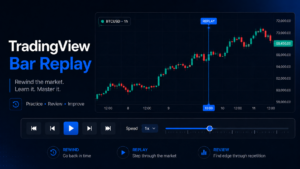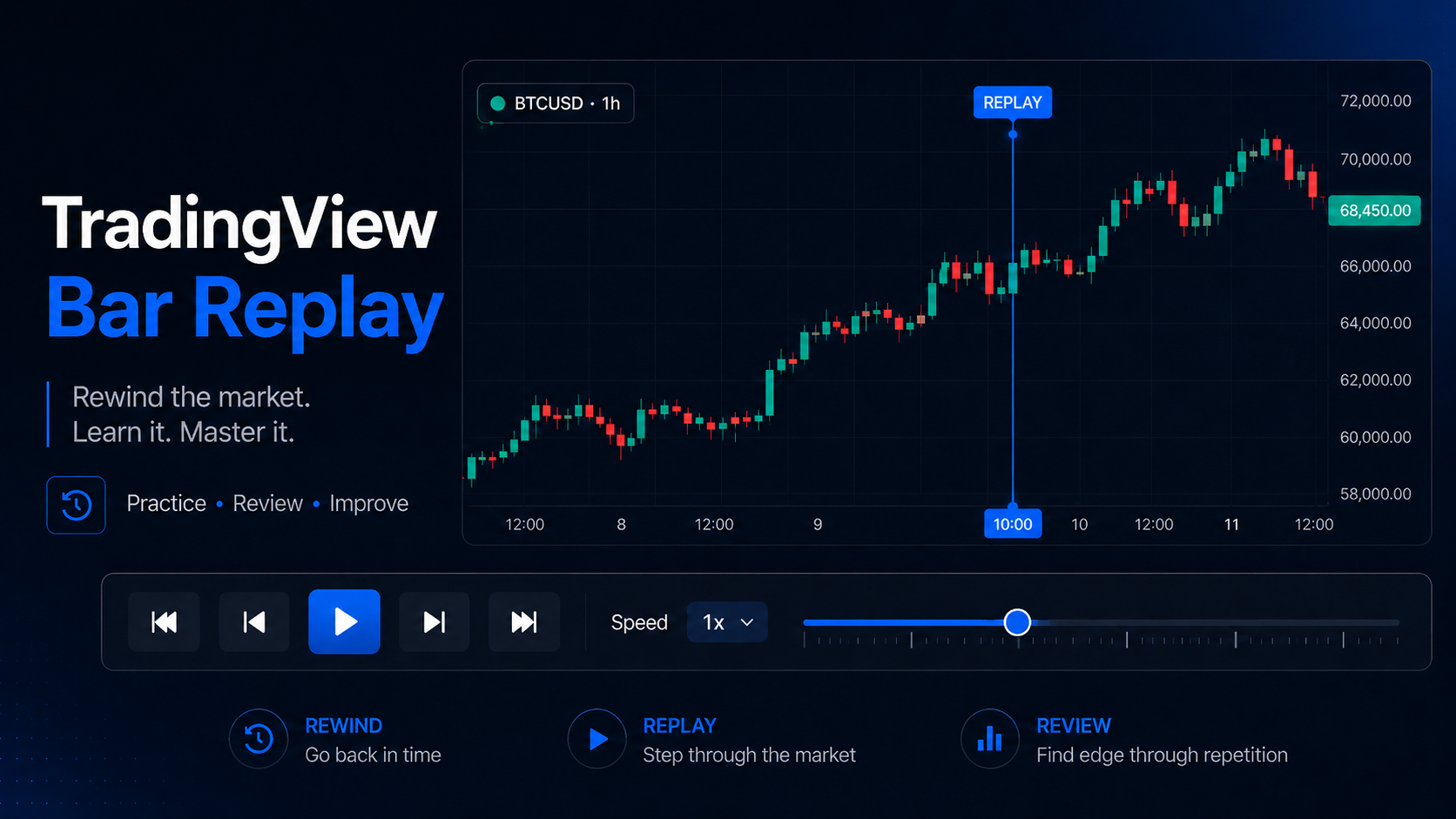
TradingView Bar Replay is useful because it lets you hide future candles and move through historical price action one bar at a time. That immediately removes one of the biggest problems with manual chart review: knowing what happens next.
But that does not automatically make the backtest clean. You can still introduce bias by starting Replay too close to a setup you already remember, assuming perfect fills, changing rules mid-test, or introducing bias in a dozen other ways.
Bar Replay is a testing environment, but it doesn’t guarantee unbiased testing. I have seen traders use Replay very carefully and get useful insight from it. I have also seen people click through old charts, subconsciously adjust their rules as they go, and end up with a strategy that looks far better in hindsight than it ever would in real time.
The tool is only as good as the process around it. If you want your Replay results to mean something, the goal is not just to hide future candles. The goal is to make decisions as closely as possible to how you would have made them without knowing the outcome.
1. Starting Replay Too Close to the Setup
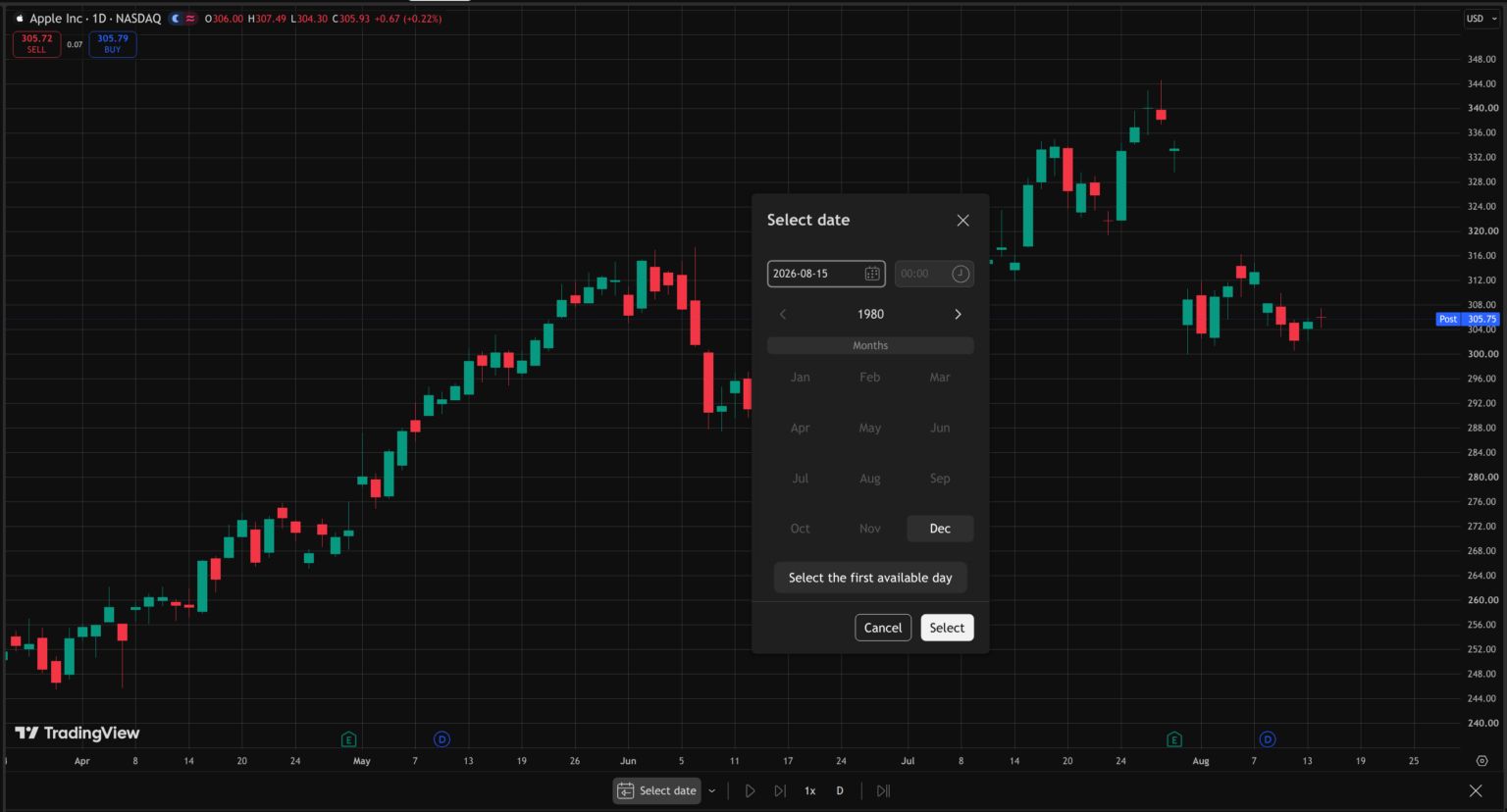
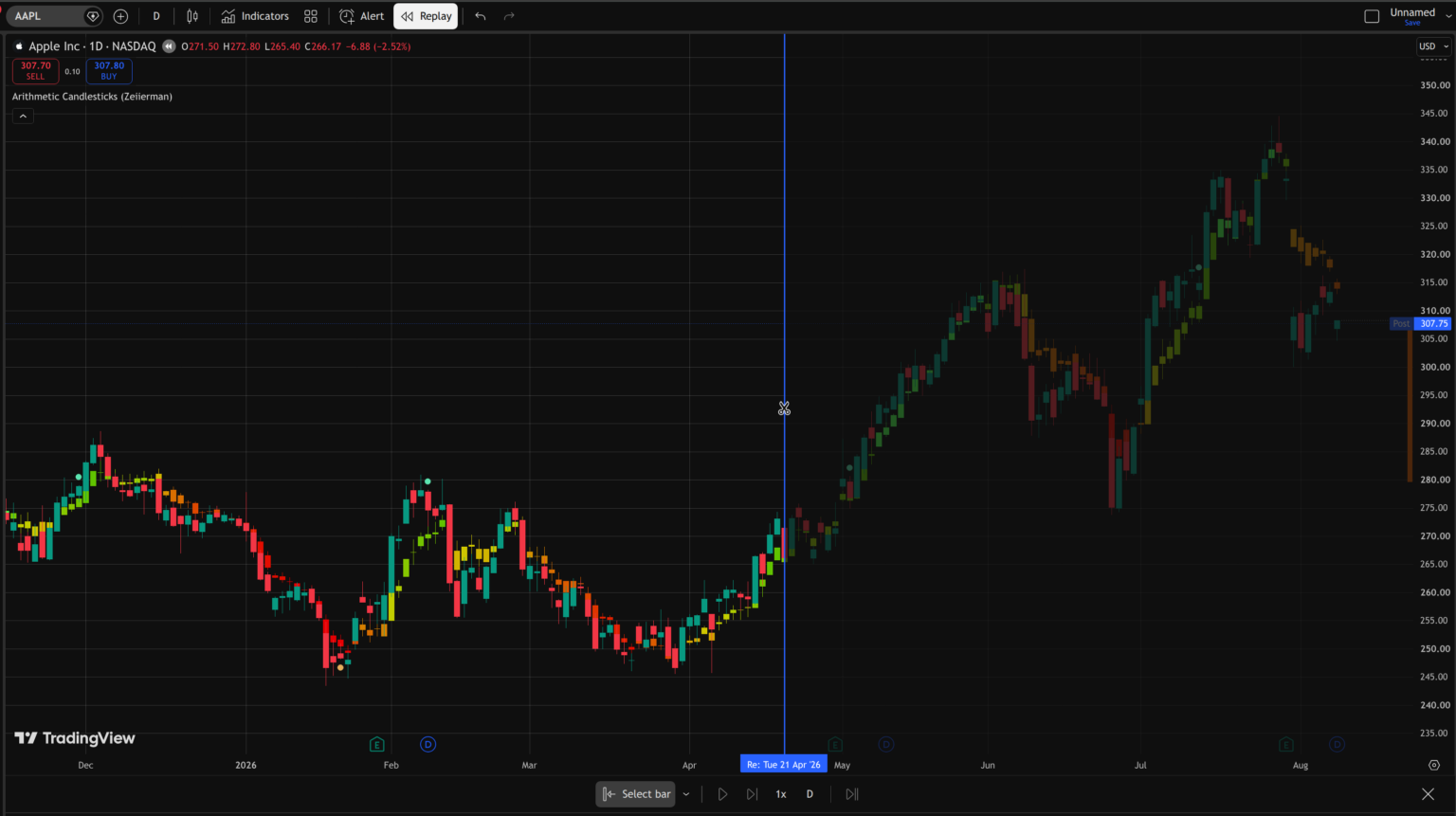
This is one of the easiest mistakes you can make that contaminates a Replay session. Imagine you are reviewing a breakout you saw earlier. You scroll directly to the area, activate Bar Replay two candles before the breakout, and then begin “testing” whether your strategy would have caught it.
The problem is that you already know something is about to happen. Even if the future candles are now hidden, that information is still in your head. You may become more patient than usual. You may interpret a weak signal as meaningful. You may pay more attention to a level simply because you already know how the price reacts there.
That is hindsight leakage, even though you technically used Replay correctly. A better approach is to begin far enough before the setup that you have to experience the context as it develops.
Ideally, when you begin a Replay session, you should not already know:
- Which level will matter most
- Whether the market will trend or range
- Whether a breakout will actually occur
- Whether the setup you are waiting for will appear at all
There is no perfect number of bars you must start earlier. It depends on the strategy and timeframe. For a simple intraday setup, that may mean starting earlier in the session. For a swing strategy, it may mean beginning several days or weeks before the eventual trade.
2. Changing the Rules After Seeing What Happens
You advance the chart, the trade starts going against you, and suddenly the setup “wasn’t quite clean enough.” Or perhaps your original stop gets hit, and you think, “I probably would have given it a little more room.” Then, on a winning trade, you accept the same kind of setup without hesitation.
That is how hindsight quietly rewrites the strategy. The cleanest way to prevent this is to record the important decisions before advancing Replay. At minimum, that means documenting why the setup is valid, the entry, stop, target, and any required filters.
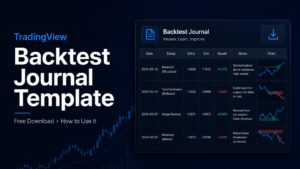
This is exactly why we built those fields into our TradingView Backtest Journal Template. The point isn’t to make the process rigid for its own sake. The point is to make sure you evaluate the strategy you actually defined, not the version that looks best after the chart is finished.
Read: TradingView Bar Replay Plans, Data Limits & Timeframes: How Far Back Can You Replay?3. Only Replaying the Setups You Already Like
Another easy way to create a flattering backtest is to test only the setups that already look appealing. You scroll through history, see a clean breakout, start Replay, record the result, and then move forward until the next obvious setup catches your eye. The trades you end up testing may all be valid. The problem is the trades you never included.
You may have skipped messier but still rule-compliant setups, loss-making setups, quiet market conditions, periods where signals were harder to identify, or simply setups that looked unattractive in hindsight. That creates selection bias.
A strategy is not really being tested if you only allow its nicest historical examples into the sample. This does not mean you need to record every candle or every vague pattern you see. What you do need is a repeatable rule for deciding which setups enter the backtest.
For example, if your strategy says: “Take every valid breakout retest during the London session when conditions A, B, and C are present,” then every historical setup meeting those conditions should be treated consistently, whether the chart looks beautiful or ugly afterward.
This is another reason starting Replay earlier matters. If you move through the market naturally, you are more likely to encounter valid opportunities as they develop instead of hunting backward for charts that already look interesting.
4. Testing One Market Environment and Calling the Strategy Proven
A strategy can look excellent when the market environment happens to suit it. That is why testing a large number of trades from one regime can still give you a false sense of confidence.
For example, imagine you test a long breakout strategy during a strong bull market. You might collect 100, 150, or even 300 trades and come away with impressive results. But what have you really learned?
Mostly, how that strategy behaves when directional momentum is favorable, breakouts are being rewarded, pullbacks are relatively shallow, and risk appetite is strong. That is useful information, but it is not the same as proving the strategy is robust.
The same setup may behave very differently during sideways markets, high-volatility selloffs, low-volatility conditions, bearish trends, choppy sessions, etc. This is why market-regime coverage matters just as much as raw trade count. A backtest should expose the strategy to enough variation that you can see where it performs well, where it struggles, and whether the edge appears dependent on one specific environment.
That does not mean every strategy needs to work everywhere. Some systems are intentionally designed for trends. Others only make sense during ranges. The important part is knowing that limitation. If your results only look good in one regime, that is still useful knowledge. It just means you shouldn’t treat the strategy as universally reliable.
5. Using Unrealistic Entries and Exits
Bar Replay makes it easy to assume cleaner execution than you would probably get in live trading. Historical candles show where price traded, but that doesn’t automatically mean you could have entered or exited at the exact price you want. These details matter even more on lower timeframes, where a few ticks can significantly change the result.
Suppose your strategy enters on a breakout. In Replay, you may see price touch your entry level and immediately continue in your favor. It is tempting to assume you were filled perfectly. In live conditions, however, you may have experienced spread, slippage, or a fast move that made the ideal price difficult to capture.
The same applies to exits. If a candle touches both your stop and target, you cannot simply choose whichever result looks better unless the strategy and data resolution clearly tell you which was hit first. A cleaner approach is to build conservative execution assumptions into the backtest.
That may mean accounting for spread and commission, avoiding unrealistically precise fills, using lower-timeframe data when entry order matters, recording ambiguous trades separately instead of forcing a favorable result, and more.
6. Replaying Too Fast
Bar Replay can become misleading when you start clicking through candles too quickly. At that point, you are no longer really testing decision-making. You are just watching history unfold. That matters because live trading is not a slideshow. If you advance ten candles in a few seconds, most of “the process” disappears.
You may miss setups entirely. You may unconsciously wait until the “important” move becomes obvious. You may spend far less time evaluating context than you ever would in a live market. This is especially problematic with discretionary strategies.
If your system depends on structure, liquidity, momentum, order flow, or the quality of a retest, then how you interpret those conditions is part of what you are testing. So slow the Replay down whenever a real decision would normally be required. And pause when a setup is beginning to form, entry criteria may be met, your stop or target needs to be defined, market context changes, or whenever you would realistically need to make a decision.
There is nothing wrong with moving quickly through completely irrelevant sections of the chart. The mistake is speeding through the exact moments where your strategy requires judgment.
The closer your Replay process resembles the decisions you would have to make live, the more useful the exercise becomes.
Read: TradingView Bar Replay Not Working: Missing Button, Toolbar & Fixes7. Recording Only Wins, Losses, and P&L
A backtest that records only Win, Loss, and Profit/Loss leaves out most of the information you actually need to improve a strategy. Suppose two trades both lose. One was a perfectly valid setup that followed every rule. The other was entered late, taken in poor market conditions, and violated the strategy from the start.
If both rows simply say, Loss: -1R, you have treated two very different problems as if they were the same. A useful Replay journal should give you enough context to answer questions like:
- What setup was being tested?
- What market regime was present?
- Were the rules followed?
- Was the execution good?
- Did you make any mistakes or deviations?
- Was the result caused by the strategy or by how you applied it?
This is why I prefer recording both strategy performance and execution quality.
Our TradingView Backtest Journal Template includes fields for market context, regime, planned entry, stop, target, realized R, rule adherence, execution quality, deviations, notes, and screenshots. You do not need to write a paragraph for every trade. You just need enough consistent information that, after 50 or 100 tests, you can see patterns beyond the headline win rate.
8. Treating Bar Replay Results as Live-Trading Proof
Even a clean Bar Replay backtest is still a historical test. That sounds obvious, but it is easy to forget once a strategy starts producing attractive numbers. Bar Replay can help you test a lot, but it cannot reproduce live trading.
There is also a psychological difference. During Replay, even when future candles are hidden, you still know you are working with historical data. You can pause, restart, and review without real money or real-time pressure involved.
That is why I would not treat a strong Replay result as proof that a strategy is ready for live capital.
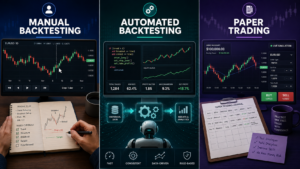
A better progression is: Historical backtest → paper or forward test → live deployment only after the strategy continues to hold up
Paper trading and forward testing give you a chance to see whether the rules still make sense when the market is genuinely unfolding in front of you.
9. A Better Bar Replay Routine
Most mistakes in this article come from the same underlying problem: the trader is trying to make the historical test look good instead of making it realistic. A cleaner Bar Replay process can be surprisingly simple:
Define the rules → Start before the setup → Let the market develop → Record the plan → Take every valid setup → Log the result and execution → Review the sample → Forward test
The important part is consistency.
Before you begin:
- Define what counts as a valid setup
- Decide how entries, stops, and targets will be handled
- Decide which markets and sessions are included
- Decide how spread, commission, and ambiguous fills will be treated
During Replay:
- Avoid jumping directly to known moves
- Do not change the rules because of the outcome
- Record the trade before advancing the chart
- Include valid losses, not just attractive winners
- Slow down when the strategy requires judgment
Afterward:
- Review more than win rate
- Separate strategy performance from execution quality
- Check whether results depend on one market regime
- Look for recurring mistakes and deviations
- Move into forward testing when the historical sample stops giving you much new information

Zeiierman
With over 16 years in the market, Zeiierman has extensive experience as a full-time trader and risk advisory consultant for hedge funds. He has developed many profitable trading strategies, drawing on his background in risk management and strategy execution.
More from Zeiierman