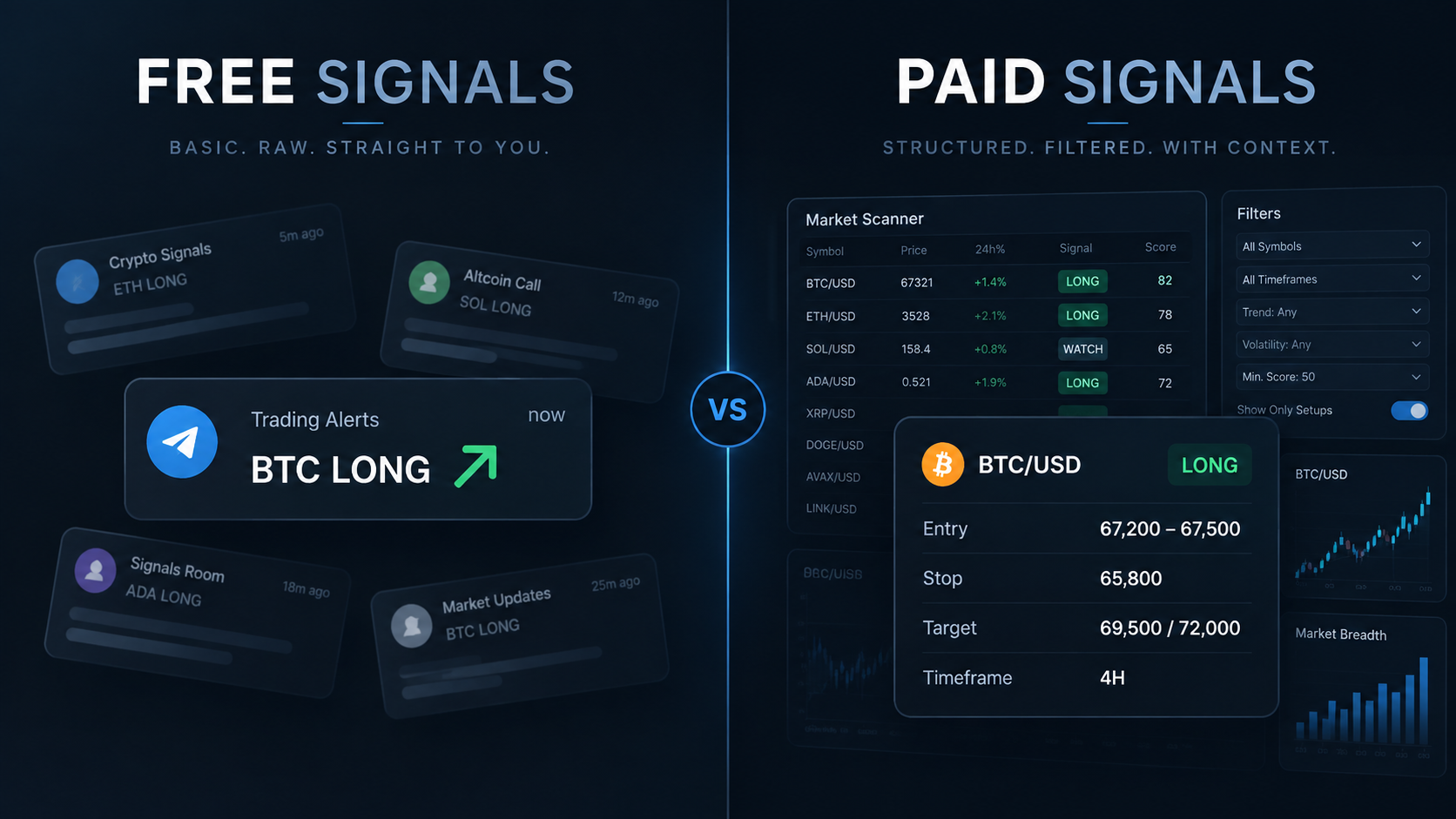
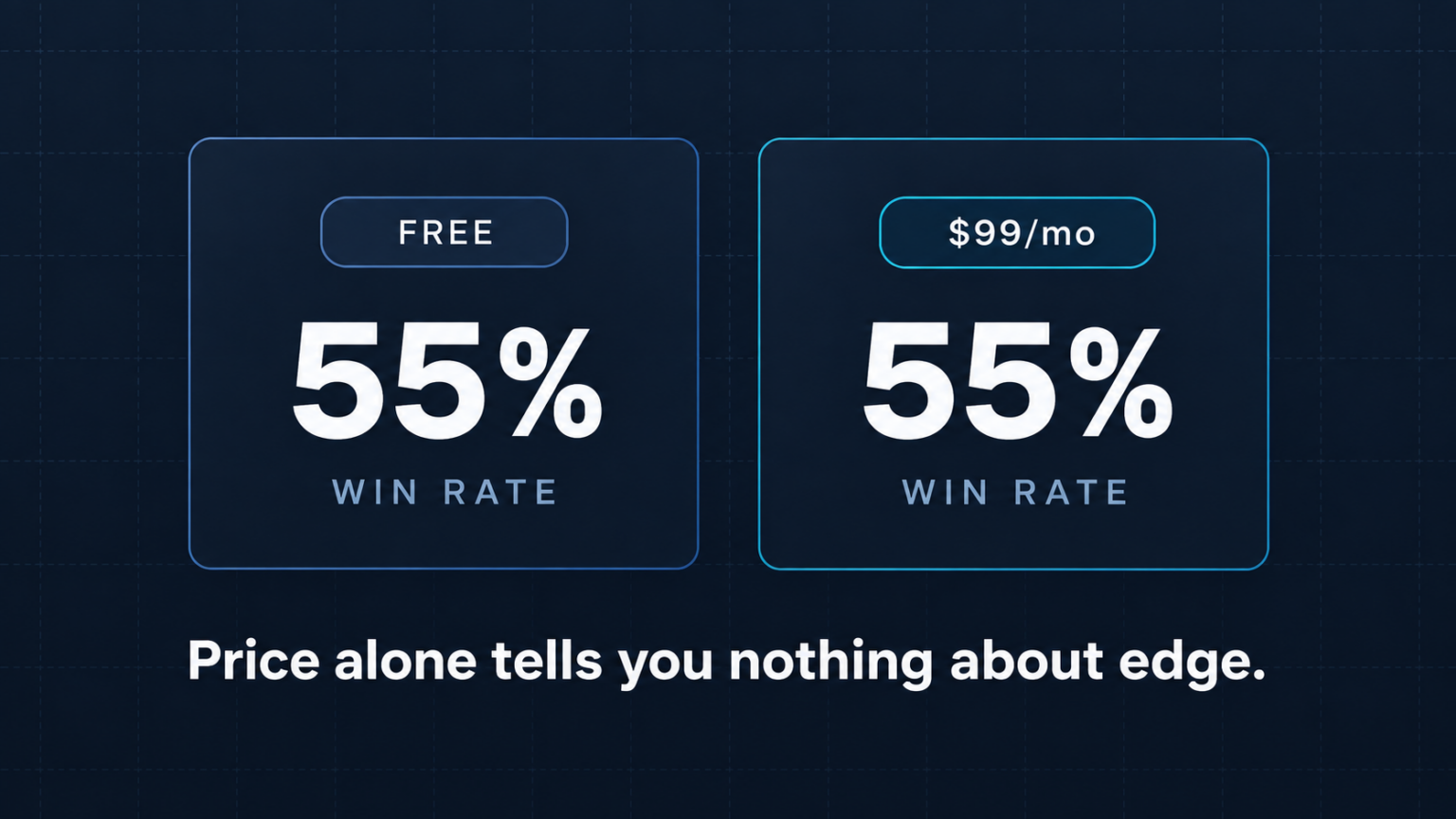
One of the easiest assumptions to make about trading signals is that a paid service must somehow produce better trades than a free one. In practice, price alone tells you little about a signal’s quality.
A more useful way to compare free and paid trading signals is to look at the work being done around the signal itself. A paid service might give you a defined entry, stop-loss, targets, timeframe, and market context instead of simply telling you which direction to trade. It may also scan far more markets, filter out weaker setups, monitor several timeframes, and deliver alerts consistently rather than whenever someone happens to notice an interesting chart.
A lot can also happen behind the scenes. A provider may have proprietary indicators, automated scanners, servers that monitor markets continuously, analysts reviewing setups, or systems designed to reject signals that don’t meet certain conditions. In that case, part of what you are paying for is not the individual alert that appears on your screen; it is the infrastructure and filtering process that produced it.
None of this means a paid signal is guaranteed to perform better. A subscription fee does not turn a weak trading methodology into a good one. What I would pay for is better structure, filtering, coverage, speed, consistency, and convenience.
1. Free vs Paid Trading Signals: Side-by-Side
| Factor | Free Trading Signals | Paid Trading Signals |
|---|---|---|
| Cost | No direct subscription cost | Usually subscription or one-time fee |
| Signal detail | Can range from a simple direction to a complete trade plan | More likely to follow a standardized format |
| Entry, stop and targets | Sometimes included | Commonly expected from a structured service |
| Filtering | Often more limited or manual | May use stronger screening or predefined criteria |
| Market coverage | Often focused on fewer markets | Can monitor a broader range of assets and timeframes |
| Delivery | May be irregular | Usually expected to be more consistent |
| Monitoring and updates | Often limited | May include expiry, invalidation or target updates |
| Support/community | Usually basic | Often included as part of the subscription |
| Trader workload | More analysis and filtering may remain with you | A larger part of the screening process may be handled for you |
| Accuracy | Not guaranteed | Still not guaranteed |
2. What Do Free Trading Signals Usually Look Like?
Free trading signals can come from almost anywhere traders gather online: Discord and Telegram communities, X, TradingView ideas, newsletters, broker communities, indicator alerts, or the free tier of a larger paid service. The range of quality is enormous since the barrier to publishing is so low.
At one end, you might receive a basic directional call such as “Buy EURUSD.” At the other, a free signal may include the entry zone, stop-loss, multiple targets, timeframe, chart analysis, and an explanation on top of it all, which is why I would avoid using free as shorthand for low quality. It is still useful to understand why a provider gives signals away.
Some traders may enjoy sharing their analysis to build a community. Others use them as a preview of a paid service. Some providers also support free content through broker partnerships, affiliate commissions, or other routes. None of those models automatically makes the analysis unreliable, but knowing the incentive helps you understand what you are being shown.
The only practical question is whether the free signal gives you enough information to make a sensible decision. If you already perform your own analysis, a simple trade idea may be all you need.
Read: Why TradingView is Perfect for Beginners in 2025A. The Hidden Cost of “Free” Trading Signals
Free trading signals don’t cost money, but that doesn’t always mean they cost you nothing.
If you receive ten, twenty, or forty alerts every day and need to check every chart yourself, verify the setup, determine the timeframe, work out the stop, calculate the target, and decide whether the trade is even worth considering, then the service has pushed most of the analytical workload back onto you.
That can be perfectly acceptable if that is what you want. In fact, for traders who enjoy doing their own analysis, a free signal can work well as an idea generator. The problem is when the volume of low-context alerts creates more noise than value.
You can also pay indirectly through inconsistency. A free channel may post regularly for two weeks and then go quiet. Alerts may arrive late, formatting may change, and some trades may have stops or targets while others do not.
Promotional bias can be another hidden cost. If a free signal channel exists mainly to push users toward a broker, paid group, course, or affiliate offer, you may be incentivized to publish attention-grabbing setups rather than disciplined ones.
The simplest way to think about it is this: free signals often save you money, while paid signals are supposed to save you time or improve structure. Whether that trade-off is worth it depends entirely on how you trade. If you are happy to do the filtering yourself, free signals may be more than enough. If you are trying to outsource the filtering, the lack of a subscription fee may matter less than the work you still have to do.
3. What Are You Actually Paying for With Paid Signals?
The biggest mistake is thinking that the fee is simply buying access to “better calls.” In many cases, the real value lies in the signal rather than the directional idea itself.
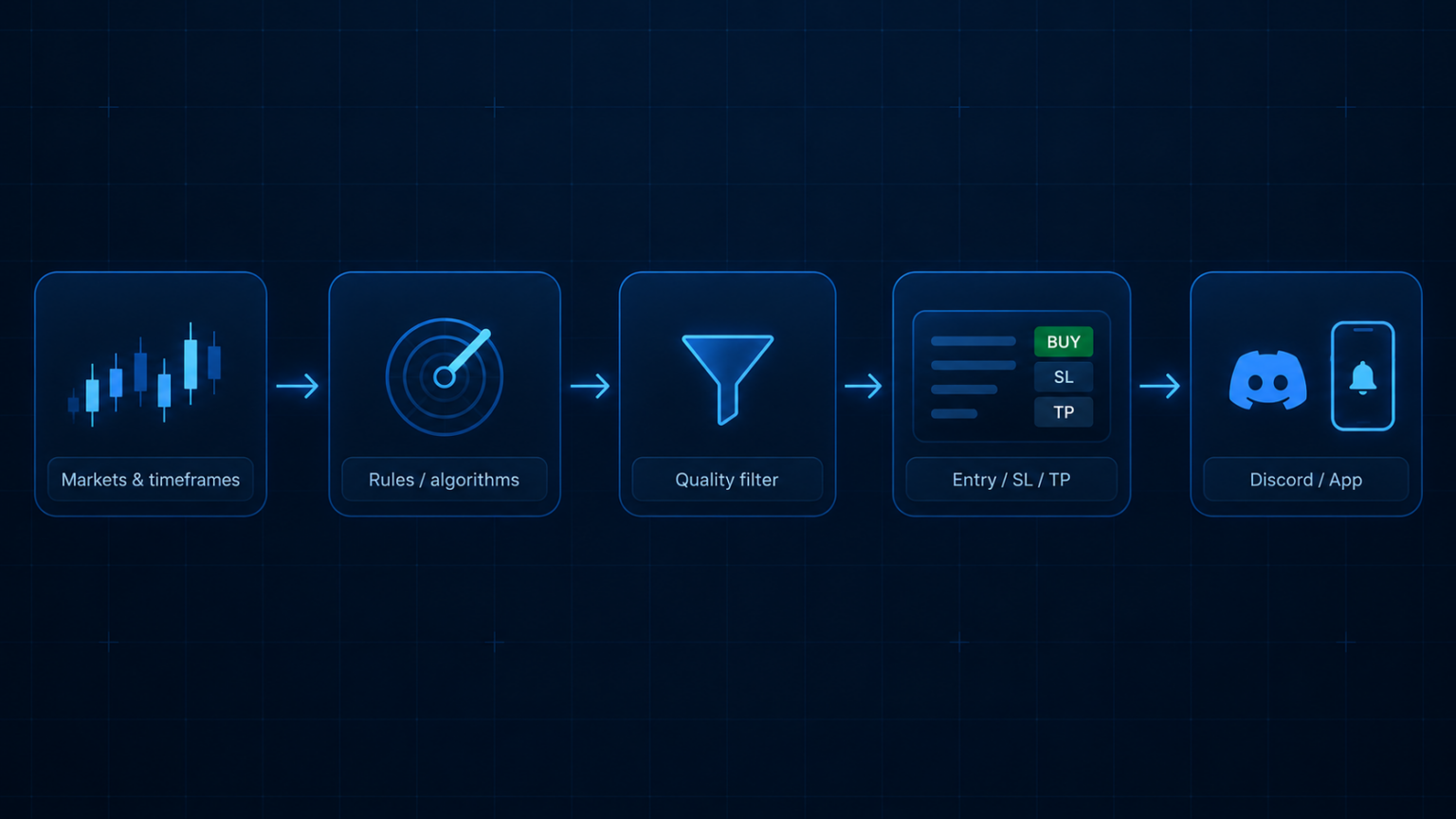
A paid service may give you a much more complete trade plan. An ideal paid service would give you an entry zone, stop-loss, targets, timeframe, invalidation level, and some explanation of the setup. That structure matters because it gives you something you can actually evaluate. You can compare potential reward against risk and decide whether the setup fits your trading plan.
The second major value is filtering. A serious signal system may monitor dozens of markets, check several timeframes, apply technical filters, and reject setups that fail to meet certain conditions. From a trader’s point of view, filtering can be more valuable than the alert itself because it reduces the amount of time spent hunting through charts.
Coverage is another factor. A free channel may focus on Bitcoin, gold, or a handful of major forex pairs because those markets are easiest to follow manually. A paid system may cover a much broader universe and monitor it continuously.
Delivery and consistency also matter more than they initially appear to. If a provider has the infrastructure to monitor conditions continuously and send alerts the moment a setup qualifies, that can be materially different from an analyst manually posting an idea whenever they happen to be online.
Then there is the infrastructure behind everything. Proprietary indicators, scanners, servers, backtesting, development, analysts, and support all cost time and money to maintain. Sometimes the subscription pays for access to that entire system rather than the individual message that eventually lands in your Discord or app.
A. What Paying Does Not Guarantee
Paying for signals does not remove uncertainty from trading. That may sound obvious, but signal marketing can make it easy to forget. A provider can charge $20, $100, or $500 per month and still have a weak process behind the service. Likewise, a free analyst can publish thoughtful, well-defined setups.
You also need to be careful how performance is presented. A service might advertise a high win rate without showing average winner size, average loss, drawdown, sample size, or how it recorded the results. A 75% win rate can, for example, still produce poor results if losing trades are much larger than winners, while a lower win-rate strategy can perform well if the reward-to-risk profile is stronger.
The same applies to execution. A signal may look excellent on paper, but your result can still differ because of spread, slippage, delay, position sizing, or simply because you entered at a different price. Two traders following the same alert can end up with very different outcomes.
Paid signals also do not remove the need for risk management. If you over-size every trade because you trust the provider, a short losing streak can still do serious damage. This is why I would never use price as a proxy for quality.
4. When Free Trading Signals May Be Enough
In many cases, free signals are perfectly adequate, especially if you already have a process for analyzing the market yourself. If you mainly use signals for ideas, there is little reason to pay just for someone to tell you that Bitcoin, gold, or EURUSD looks interesting. You can take that idea, open the chart, compare it with your own analysis, and decide whether the setup fits your rules.
Free signals can also work well if you trade only a few markets or don’t need constant coverage. If you follow two or three instruments and already know them well, you may not gain much from paying for a system that scans dozens of additional assets.
The same applies if speed is not especially important to your strategy. A swing trader who makes a few decisions each week can usually afford to review an idea manually. An intraday trader who depends on timely entries has much less room for delay.
For newer traders, free signals can also be useful as a learning tool, as long as you don’t treat them as instructions. Compare the signal with the chart. Ask why the entry was chosen, where the idea becomes invalid, and whether the target makes sense relative to the risk. Used that way, even a signal you never trade can still teach you something.
Free signals are generally enough when you are comfortable doing the final layer of work yourself. If you can evaluate the setup, define your own risk, and filter out ideas that don’t suit you, paying for additional structure may be solving a problem you do not have.
Read: How to Get Started with Automated Trading: From Idea to Live Bot in 3 Simple Steps5. When Paying for Trading Signals May Make Sense
The case for paid signals gets stronger when the service removes work you genuinely don’t want to do yourself. For an active trader, manually scanning dozens of markets across several timeframes can take a lot of time. If a signal system can monitor those markets continuously, apply a consistent set of conditions, and bring a smaller number of relevant setups to your attention, then you are effectively paying for screening and time savings.
Structure can be just as important. A trader may not want to receive a directional idea and then spend the next ten minutes working out the stop, timeframe, risk-to-reward, etc. A well-designed paid service can standardize that information – which makes each opportunity easier to assess.
As I mentioned earlier, coverage is another important factor here. If you trade across crypto, forex, indices, commodities, or a wide range of stocks, it becomes difficult to monitor everything manually. A system that can watch more instruments and timeframes can surface opportunities you would otherwise never see.
There is also value in consistency. A properly maintained service should not depend on whether one analyst happens to be online that day. The methodology, delivery process, and signal format should remain relatively stable, making it easier for you to build your own routine around it.
That is the standard I would use when deciding whether paying makes sense. The subscription should either save meaningful time, improve the quality of information you receive, broaden your coverage, or make your trading process more organized. Ideally, it should do several of those things at once.
6. Should You Pay for Trading Signals?
The useful comparison is not free versus paid. It is what the service actually does for you.
Before paying, look at the information you receive, how signals are generated or filtered, how consistently they are delivered, and whether the service reduces work you would otherwise have to do yourself. A higher price only makes sense if there is something tangible behind it.
The same applies to free services. If a free source gives you well-defined setups that fit the way you trade, paying for another provider simply because it looks more professional may add very little.
I would therefore ask one question before subscribing: What am I getting here that I cannot reasonably do myself, or get elsewhere for free?
I would start with free signals if I mainly wanted ideas and was comfortable doing the analysis myself. There is little reason to outsource work I already enjoy and can do competently. Following that, I would consider paying when the service solves a specific bottleneck: I cannot monitor enough markets, I want setups filtered before they reach me, I need faster delivery, or I want each signal presented with enough structure to evaluate it quickly.
Either way, I would still treat the signal as an input to my trading process, not a command to enter a position. The provider can identify an opportunity, but the trade still has to make sense for my strategy, risk tolerance, and current market conditions.

SM_Trader
SM_Trader is a highly experienced coder and strategy developer who brings the most complex algorithms to life. As a member of MENSA, the prestigious organization for individuals with intelligence scores in the top 2% of the world, he combines exceptional analytical skills with a keen eye for numbers and statistics, empowering businesses to grow at the right pace and in the right direction.
More from SM_Trader