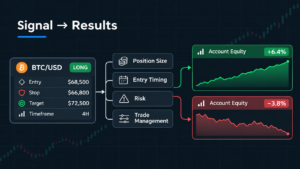
Yes, beginners can use trading signals. In fact, a well-structured signal can make parts of learning easier by showing you how a trade is put together. However, I would not use signals as a substitute for learning how trading works.
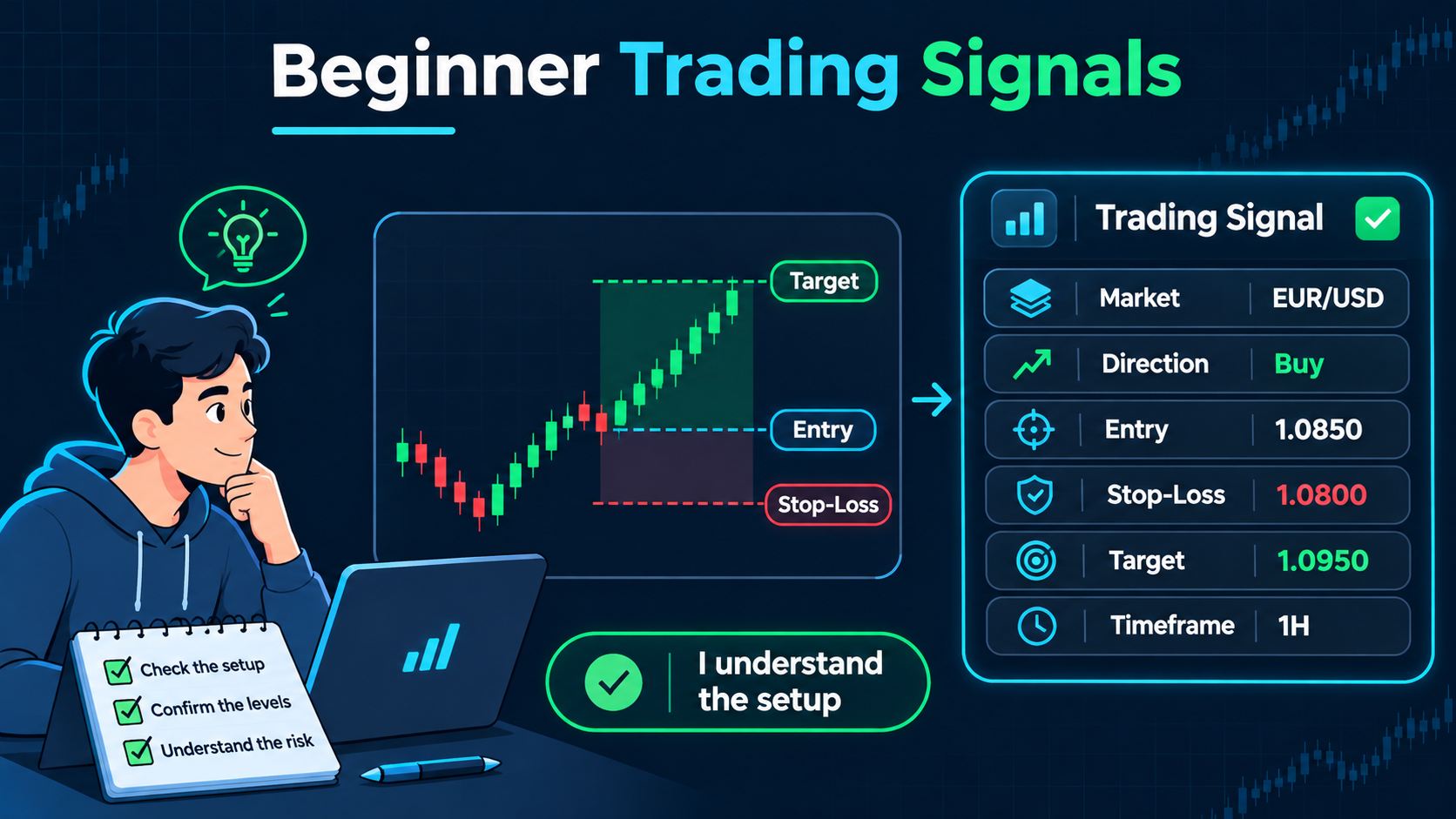
There is a big difference between using a signal to study a setup and make a better-informed decision versus using one because you do not understand the trade. A trading signal may give you the market, direction, entry, stop-loss, target, and timeframe. It can undoubtedly remove some of the work involved in finding opportunities, but it won’t replace the need to understand the logic behind the move and the risk involved.
For a beginner, that should be the goal: use signals to reduce complexity while you are still learning, not to avoid learning altogether. You do not need to become an expert technical analyst before you start using them.
1. What Should a Beginner Know Before Using Trading Signals?
Let’s get the important thing out of the way first: You don’t need to understand every indicator, pattern, or advanced trading concept before using signals. But there is a basic level of knowledge I would consider necessary before putting real money behind one. At minimum, you should understand what it means to go long or short, how market and limit orders work, what an entry price, stop-loss, and take-profit are, and how the timeframe affects the trade.
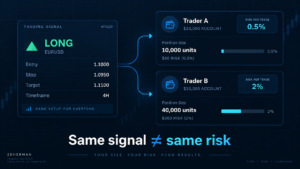
Risk is even more important. You should understand that a stop-loss tells you where to exit a trade if it goes wrong, but it doesn’t tell you how much of your account to risk. That depends on your position size. You should also have a basic understanding of leverage, especially if you are trading forex, crypto, futures, or any other leveraged market. A perfectly reasonable signal can still become dangerous if the position is oversized.
In our mentorship programs, we tend to use a simple standard for new students. You do not need to be able to find the trade yourself yet. You should be able to understand the trade once it is shown to you.
Suppose a signal says:
- Entry: 100
- Stop-loss: 95
- Target: 110
You should be able to tell that you are risking 5 points to potentially make 10, that the setup offers roughly 2:1 reward-to-risk, and that the trade is considered invalid if price reaches the stop. You must also be able to decide how much money you’re willing to lose if that happens. If those pieces still feel unclear, I would learn them first before following live signals with real capital.
2. How Trading Signals Can Actually Help Beginners Learn
A signal’s biggest advantage, in terms of education, is that it gives you a real trade to study instead of leaving you alone with an empty chart. When you first start trading, it can be difficult to know what deserves your attention. There may be dozens of indicators, price levels, patterns, and timeframes on the screen, but very little context for how those pieces come together into an actual trade.
A structured signal gives you a starting point. You can look at the proposed entry, stop-loss, target, and timeframe, then work backward and ask why those levels were chosen. That process can gradually make trade structure easier to understand. You will start to notice that a setup is not simply a prediction that price will move higher or lower. It is a defined idea with a point of entry, an invalidation level, a potential reward, and a known amount of risk.
Signals can also expose you to more setups than you might discover on your own. Instead of manually scanning dozens of markets while you are still learning what to look for, you can study opportunities that have already passed through a provider’s methodology.
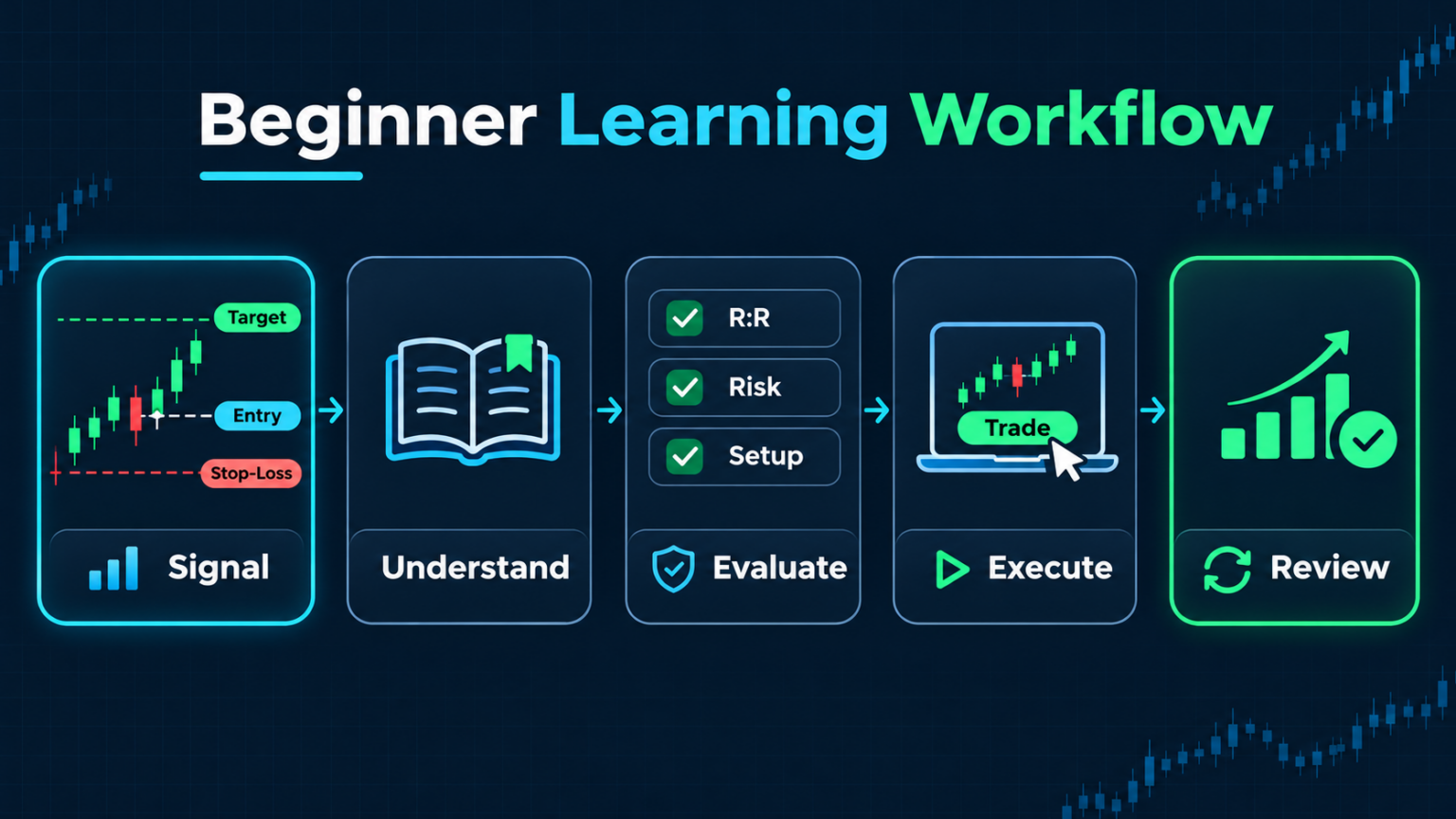
The important part is what you do with them afterward. If you review the chart, compare the signal with what actually happened, and keep asking why the trade was structured that way, the signal becomes a worked example rather than just an alert. Over enough trades, that can help build pattern recognition and give you a better understanding of how trading decisions are made.
3. Where Trading Signals Can Hurt a Beginner
The same convenience that makes trading signals useful can also become a beginner’s biggest weakness. If every trade begins and ends with an alert, you can become reasonably good at following signals without getting better at trading. Working mechanically and blindly following the ‘notification’ for a long time without forcing yourself to understand why the setup exists can be detrimental. The problem becomes more obvious when something changes.
Read: How to Use Trading Signals Without Blindly Following ThemA beginner might receive a signal after price has already moved significantly and enter anyway because they do not know whether the original reward-to-risk still exists. They might increase the position size because several previous signals won, move a stop because they do not want to accept a loss, or abandon the service after a normal losing streak because they assumed good signals should win almost all the time.
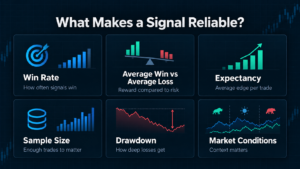
It is also easy to confuse a structured signal with certainty. A stop-loss does not make the trade safe, and a high historical win rate does not mean the next signal is likely to win. Losses remain part of the process.
Another common problem is provider dependence. If you spend months taking trades without understanding them, you may still feel lost the moment the signal source disappears, or when you need to make a decision not covered by the original alert.
4. A Better Way to Use Signals While You’re Still Learning
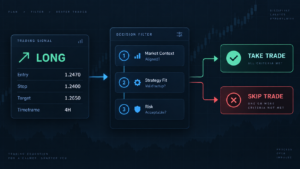
If you are still learning, I would use trading signals as a framework for practice rather than simply as instructions to execute. Before taking the trade, read the entire setup and make sure you can explain it in your own words.
- What market are you trading?
- Is it long or short?
- Where is the entry?
- Where is the stop?
- What is the target?
- How much are you actually risking if the trade fails?
If you cannot answer those questions, that is usually a sign that you should study the setup first rather than place it. Paper trading can be especially useful here. It lets you practice receiving a signal, calculating the position size, placing the trade, and managing it without adding the pressure of real money. That is useful because beginners are often learning two things at the same time: how trading works and how to use the trading platform correctly.
After the trade closes, review it instead of moving immediately to the next alert. Note whether you followed the original plan, what happened around the entry and stop, and whether you understand why the setup succeeded or failed.
5. What Does a Beginner-Friendly Signal Service Look Like?
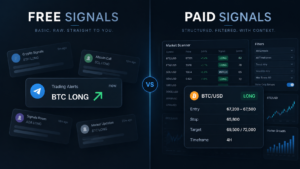
A beginner-friendly signal service should make the trade easier to understand, not more confusing. At minimum, I would expect each signal to clearly show the market, direction, entry, stop-loss, target, and timeframe. Those elements give you enough structure to understand what the trade is trying to do and where the idea becomes invalid.
Context helps as well. A short explanation of the setup, an entry range, an expiry condition, or some indication of why the trade exists can make the signal much more useful for someone who is still learning.
Read: Free vs Paid Trading Signals: What Are You Actually Paying For?The trading style also matters. Extremely fast scalping signals may be difficult for beginners because the entry can disappear within seconds. By the time you have opened the chart, understood the setup, calculated your risk, and placed the order, the original opportunity may already be gone.
A slightly slower strategy often gives beginners more time to make sensible decisions. I would also pay attention to transparency. A service should show losses as well as wins, provide enough performance history to evaluate the process, and avoid claims that suggest trading can be made risk-free.
Some common warning signs include guaranteed profits, unrealistically high win rates, no visible losing trades, missing stop-losses, or pressure to increase position size.
For a beginner, the best service is not necessarily the one sending the most signals. It is the one providing enough structure and transparency that you can understand what you are actually trading.

Zeiierman
With over 16 years in the market, Zeiierman has extensive experience as a full-time trader and risk advisory consultant for hedge funds. He has developed many profitable trading strategies, drawing on his background in risk management and strategy execution.
More from Zeiierman