Every trader dreams of consistent profits, but the reality is that most retail traders struggle to achieve long-term success. The learning curve, in trading, is a tough hill to climb. It’s exhausting, often frustrating, and the results don’t always match the invested efforts.
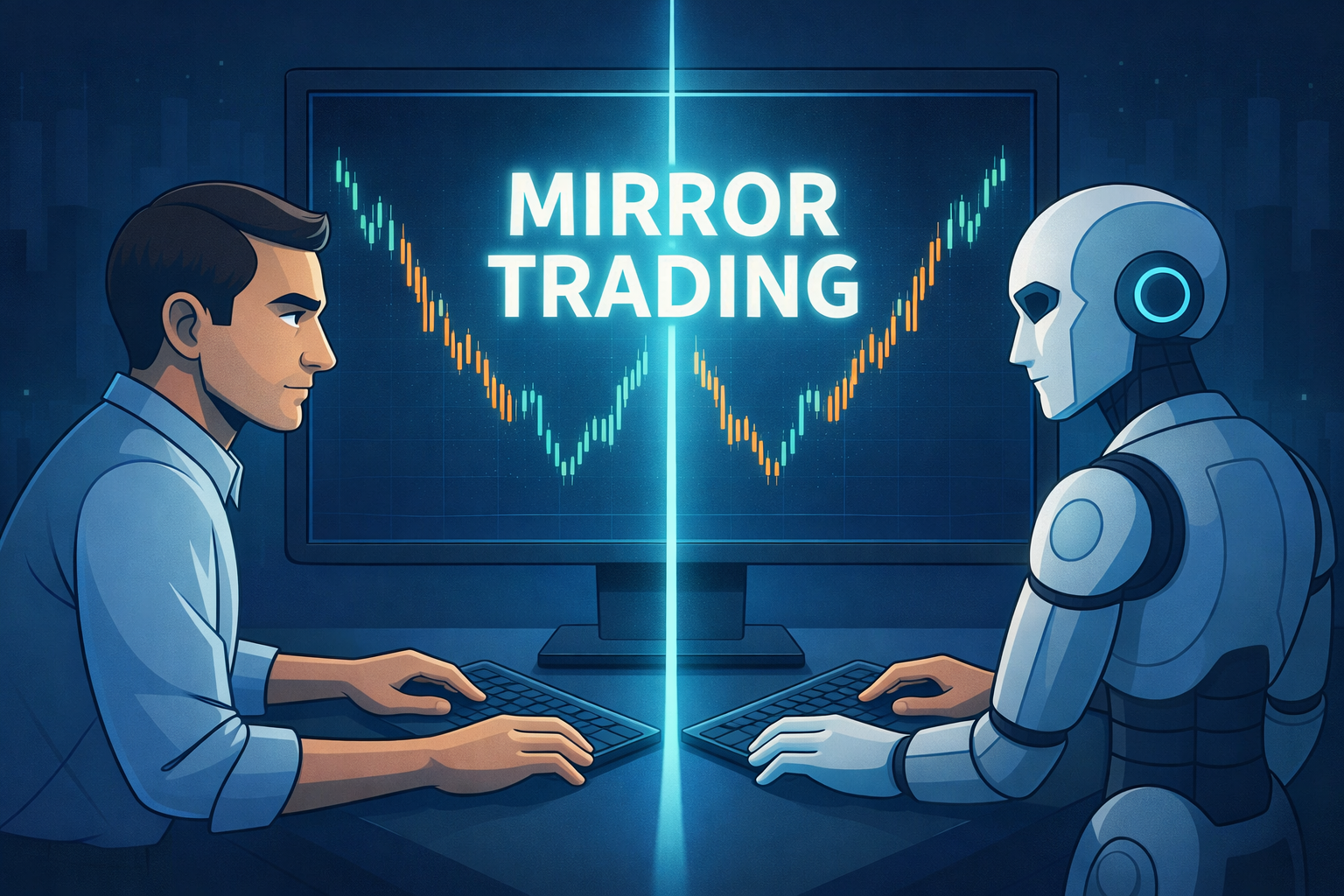
Mirror Trading is simply the automatic, real-time replication of a professional trader’s positions directly into your own account. It’s not a foolproof solution to the issue of trading being complex, but it is certainly an ingenious one when applied with care and tact.
Ever copied someone else’s answers during an exam? That’s all there is to mirror trading. Well, there’s a little more to it than that, but you get the gist. I’ll walk you through what mirror trading is, the real risks, how pros avoid mistakes, and the exact checklist you should run before committing capital.
What is Mirror Trading?
Mirror trading is the automatic replication of another trader’s strategy in real-time. When the strategy opens a position, your account opens the same (scaled to your size). When it closes, yours follows. It’s more than just copying a trade direction. Good mirror systems replicate the strategy logic, things like position sizing, trailing stops, and rule-based exits.
Why it’s useful:
- You don’t need to babysit charts all day.
- You observe professional trade rhythms.
- It helps you test whether a pro’s edge holds in your account.
📌 Tip: Your results won’t mirror the provider tick-for-tick. Latency, broker routing, spreads, and liquidity slippage can shift your entries/exits and net returns.
Highs of Mirror Trading
| Pros | Why it matters |
|---|---|
| Instant strategy execution | You participate in signals without micromanaging charts. |
| Time leverage | Free up research/analysis time; let rules fire automatically. |
| Learn by observing rules | See sizing, exits, and risk in real market conditions. |
| Diversification | Allocate across uncorrelated methods/markets. |
| Discipline by design | Removes impulse trades and FOMO entries. |
Lows of Mirror Trading
| Cons | What to watch |
|---|---|
| No guarantee future ≈ past | Regimes change; past curves can decay fast. |
| Execution drag | Slippage, latency, and spread wideners reduce your net. |
| Fee load | Performance fees + spreads/swaps can eat the edge. |
| Provider risk | Style-drift, over-optimization, or risk blow-ups happen. |
| Correlation traps | Multiple “different” providers can still be highly correlated. |
| Platform/broker limits | Copying scalpers or news spikes often performs poorly live. |
Mirror Trading vs. Copy Trading
You’ll often hear Mirror Trading and Copy Trading thrown around together, but they’re not the same. While the result for you, the end user, is similar, the subtle difference is important for understanding where your strategy originates.
Mirror Trading, for the most part, refers to replicating the entire system or portfolio strategy from a reputable fund, firm, or signal provider. You basically acquire and adopt their playbook and methodology – from how they manage risk to how they diversify and beat market philosophy.
It’s usually used to replicate more complex, algorithmic strategies, often seen in major asset classes like futures and large-scale forex trading. You are mirroring a broad, proven methodology, not just one person’s series of actions in the market.
Copy Trading usually means replicating the individual trades of a specific retail or social platform user. You are copying the play calls by linking up with a star trader on a social trading platform and copy their specific Buy or Sell decisions on an asset of your interest. This method is more popular in the retail space and often focuses on individual stocks, commodities, or cryptocurrencies.
For the average trader, the functional result is identical, where you execute trades without having to do the analysis yourself. Your platform is automatically handling the heavy lifting.
Basically, think of this like mirror = ruleset, and copy = trader themselves.
How to Choose the Right Trader to Mirror?
This is arguably the most important step of mirror trading. Choose the wrong ‘professional trader’ to ‘mirror’ and you’re basically kissing your money goodbye. The biggest mistake beginners make is picking someone based on flashy returns or a screenshot that looks like it was pulled straight out of a crypto Telegram channel.
📌 Expert Tip: Speaking from experience, it’s very important that you choose a reputable platform for mirror trading. Focus on regulation and security, a user-friendly interface with clear performance data, transparent fees, and robust risk management tools. On top of this, check out the platform’s trader selection pool to look for diverse and proven strategies with verified track records and accessible customer support.
Back to the trader you’ll replicate…
You want a trader whose approach can survive real market weather and not just the sunshine. Here is a fully loaded checklist you can use before you commit even one dollar to mirroring someone else’s strategy.
1. Evaluate Drawdowns
Drawdown is where the truth hides. Maximum drawdown is the largest loss (in percentage terms) the strategy has suffered from its peak equity value to its trough.
A low number like 10-20% shows good risk management. A high number, 70-80% means the trader is not managing risk and hasn’t been tested by a true market crash. Avoid traders with high drawdowns.
And before doing any of this, evaluate your own risk profile first. I would recommend going through the exact trades made by the traders since that data is usually given in the trade history section of the trader’s profile.
2. Win ratio and PnL ratio
These ratios are one of the first things you will come across on a trader’s profile in any copy/mirror trading platform. A win ratio in copy trading is the percentage of profitable trades out of the total trades.
A good win ratio in copy trading is generally above 50%, but a high win rate isn’t everything. A 60%-win rate with consistent small profits is often better than a 90% rate with huge, risky losses, so always check Profit Factor, Drawdown, and Risk Score alongside it to get an understanding of a trader’s actual profitability and risk, as a high win rate can be misleading without proper risk management.
3. Transparency Should Be Non-Negotiable
Before you mirror anyone, you need to understand the logic behind their approach, even at a high level. You’re not asking them to reveal their secret sauce, but you should at least know:
- What markets do they trade
- How many trades do they take per week/month
- Average risk per trade
- Stop-loss philosophy (hard stops vs soft stops vs volatility-based)
- Position-sizing rules
- Risk management habits
A trader who hides basic details is a red flag. Transparency doesn’t mean oversharing, it means you have enough clarity to assess if the approach aligns with your goals and risk comfort.
4. Study Their Equity Curve and Stats
Most traders glance at the returns column and call it a day. That’s not enough. You need to look at the shape of the equity curve because that curve is a story, it reveals the trader’s discipline, their risk tolerance, and how they behave under pressure.
There are a few factors (or indicators if you will) that I look for when I am checking out another trader. They should have smooth, steady growth over many months. Look for a track record of at least 18 to 24 months of verified data. This ensures the system has survived both bullish and bearish conditions, as well as high and low volatility environments.
It’s necessary to understand how the trader controlled pullbacks. Every real trader has drawdowns. What matters is how they handle them. A 25% drawdown that recovers in 3 months isn’t the same as one that recovers in 18 months, even though they look identical on paper.
Look for the trader’s presence outside the platform. You can find out if they are active in trading forums, Reddit, YouTube, or any other relevant social media. This can sometimes help you to evaluate the human factor or get an assurance that this trader has been active and has given value to the trading space for a considerable time.
Finally, check if the stats on the profile of the trader on the copy trading platform are not inflated. This usually happens for futures trades when a trader has not closed a big loss-making trade, which can impact the win rate. You can check the “current position” on the trader’s profile to look for any active losing trades.

SM_Trader
SM_Trader is a highly experienced coder and strategy developer who brings the most complex algorithms to life. As a member of MENSA, the prestigious organization for individuals with intelligence scores in the top 2% of the world, he combines exceptional analytical skills with a keen eye for numbers and statistics, empowering businesses to grow at the right pace and in the right direction.
More from SM_Trader