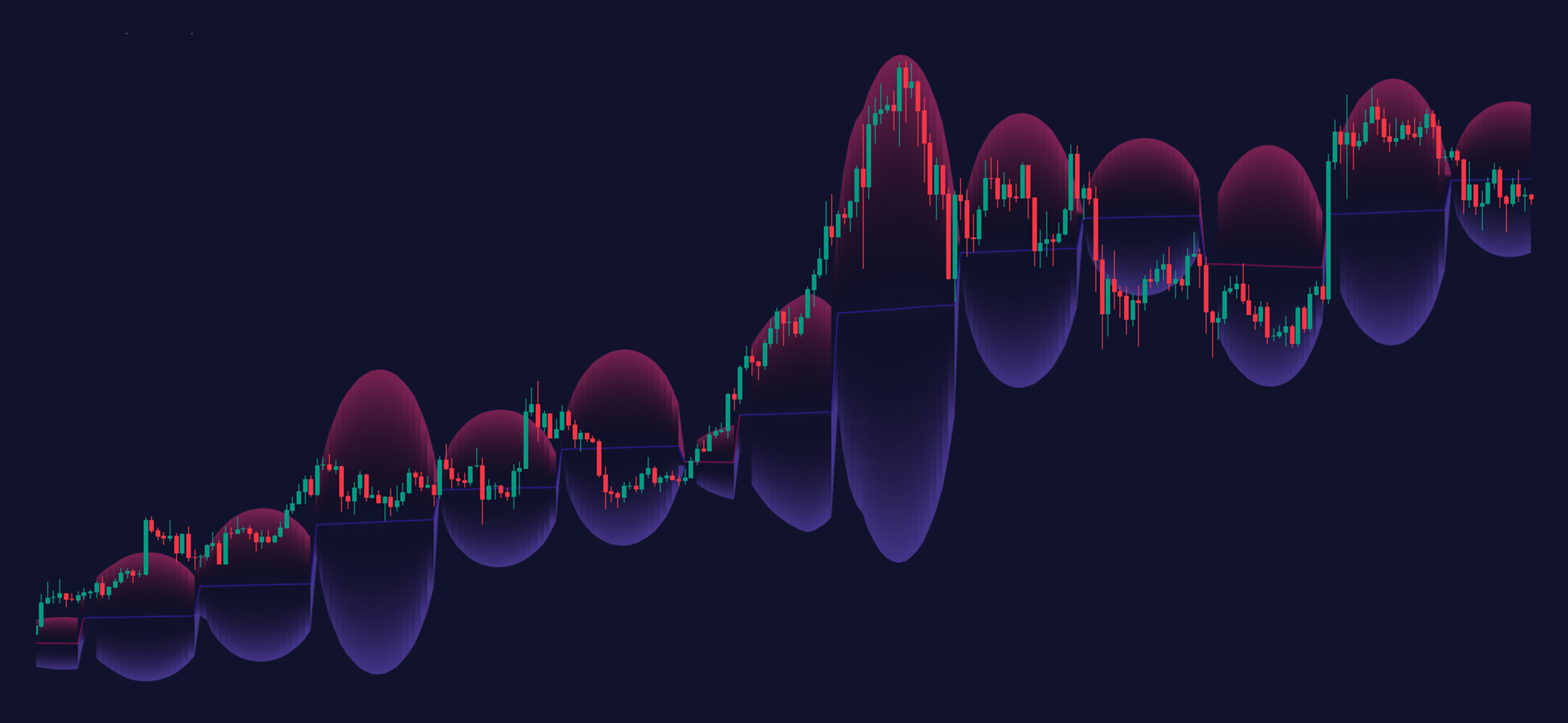
Volatility is a measure of how much an asset’s price swings over time. High volatility means faster price changes, while low volatility means gradual price movements. It’s a key indicator of risk, showing how rapidly an asset’s value can change, whether rising or falling.
Volatility is the heartbeat of every financial market. You can ignore the trend for a while, you can even miss momentum on a slow day, but volatility? It’s THE factor that determines whether a trade is riskier than your appetite allows.
On top of that, when markets expand, opportunities show up everywhere. When volatility contracts, even the cleanest setups fall flat. That’s why pro traders treat volatility as a leading indicator, not an afterthought. They use it to understand when to enter, how much to size, and when to step aside.
I did some research – mostly into my own notes and scribings over the years, but also about what other pro traders say – to determine the BEST volatility indicators you could use on TradingView. I ended up with an ultimate, foolproof list that includes the simple, classic indicators and some of the compound ones we have built over the years.
By the end, you’ll know exactly which indicators to use for your trade idea, when to use them, and how to combine them for maximum edge. Let’s begin!
If you can’t wait, here’s the list:
- Average True Range (ATR)
- Bollinger Bands
- Historical Volatility (HV)
- Chaikin Volatility (CV)
- Standard Deviation (SD) Indicator
- Volatility Trend
- Volatility Impulse (VI)
- Volatility Index
- Grid by Volatility
- Adaptive Volatility-scaled Oscillator (AVSO)
- Trend & Pullback Toolkit for Volatility Cycle
Classic Five to Build Your Foundation
Before we dive into Zeiierman’s compound tools, let’s cover the classics. These indicators have stood the test of time for a reason. They work and are available everywhere. And most importantly, they teach you how to think about volatility.
1. Average True Range (ATR)
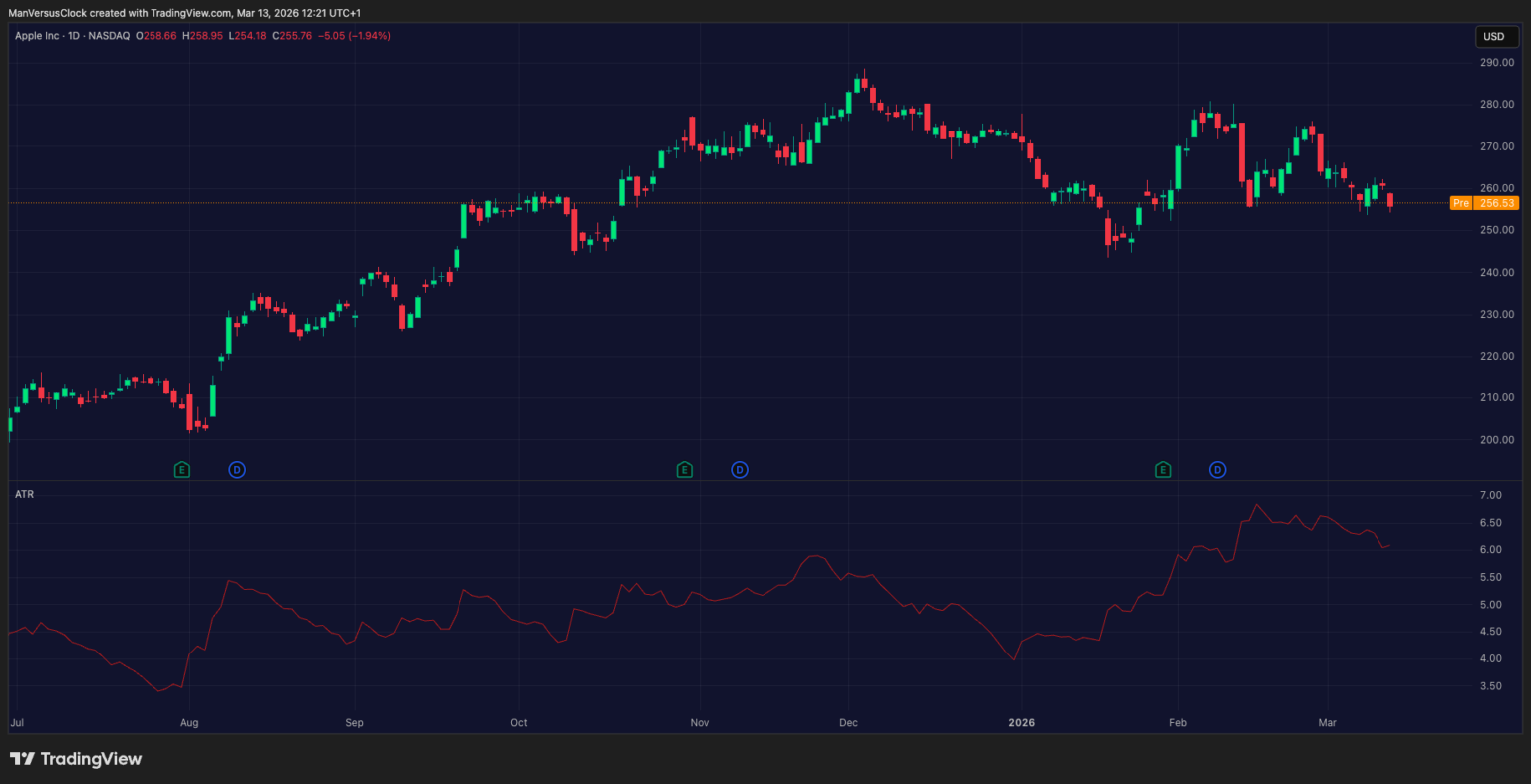
Average True Range isn’t flashy, but it’s essential. It measures the average distance a price moves over a specific period (usually 14 periods). The true range captures the largest move in a given candle, whether it’s from open to close, the previous close to the high, or the previous close to the low. It also considers gaps, which makes it more reliable than just looking at close-to-close price movement.
ATR gives a basic idea for position sizing and stop-loss placement. Day traders, swing traders managing multiple positions, and anyone who trades volatile assets like crypto or micro-cap stocks.
2. Bollinger Bands
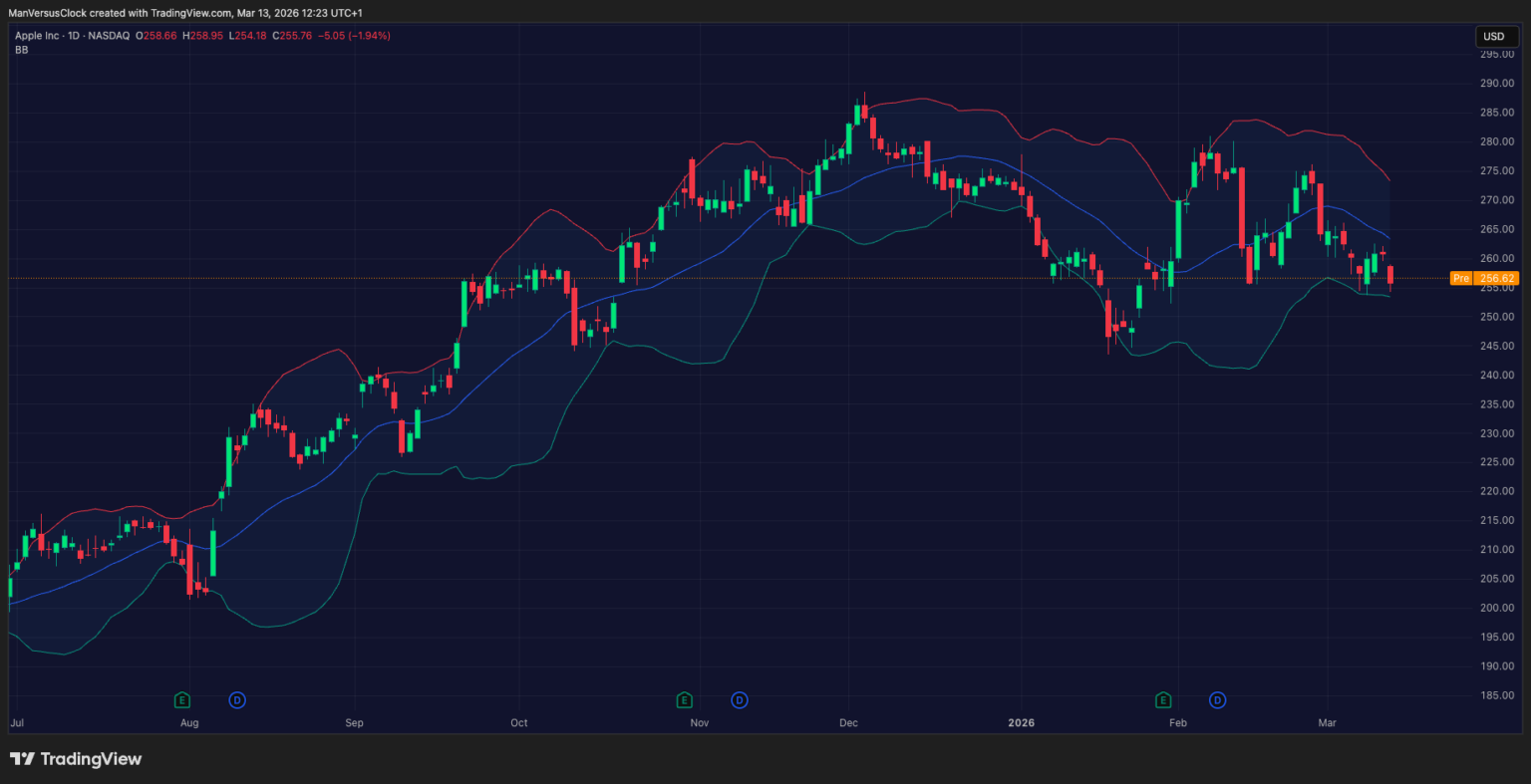
If there’s one volatility indicator even beginners know, it’s Bollinger Bands. But most traders only scratch the surface as they see the bands expand and shrink, take a couple of breakout trades, get faked out, and then assume the tool doesn’t work. These bands work incredibly well when you understand what they’re actually measuring.
Bollinger Bands blend a moving average with standard deviation. On top of price direction, they help you see how violently the price is moving around that direction. When the bands pull apart, volatility stretches. When they contract, volatility is cooling off.
3. Historical Volatility (HV)
Historical Volatility (HV) is one of those indicators that quietly sit in the background, yet it tells you something powerful: how unstable the price has been over time. Think of HV like looking at a player’s past performance stats before betting on their next game. You’re not predicting the outcome, but you’re understanding the kind of player you’re dealing with.
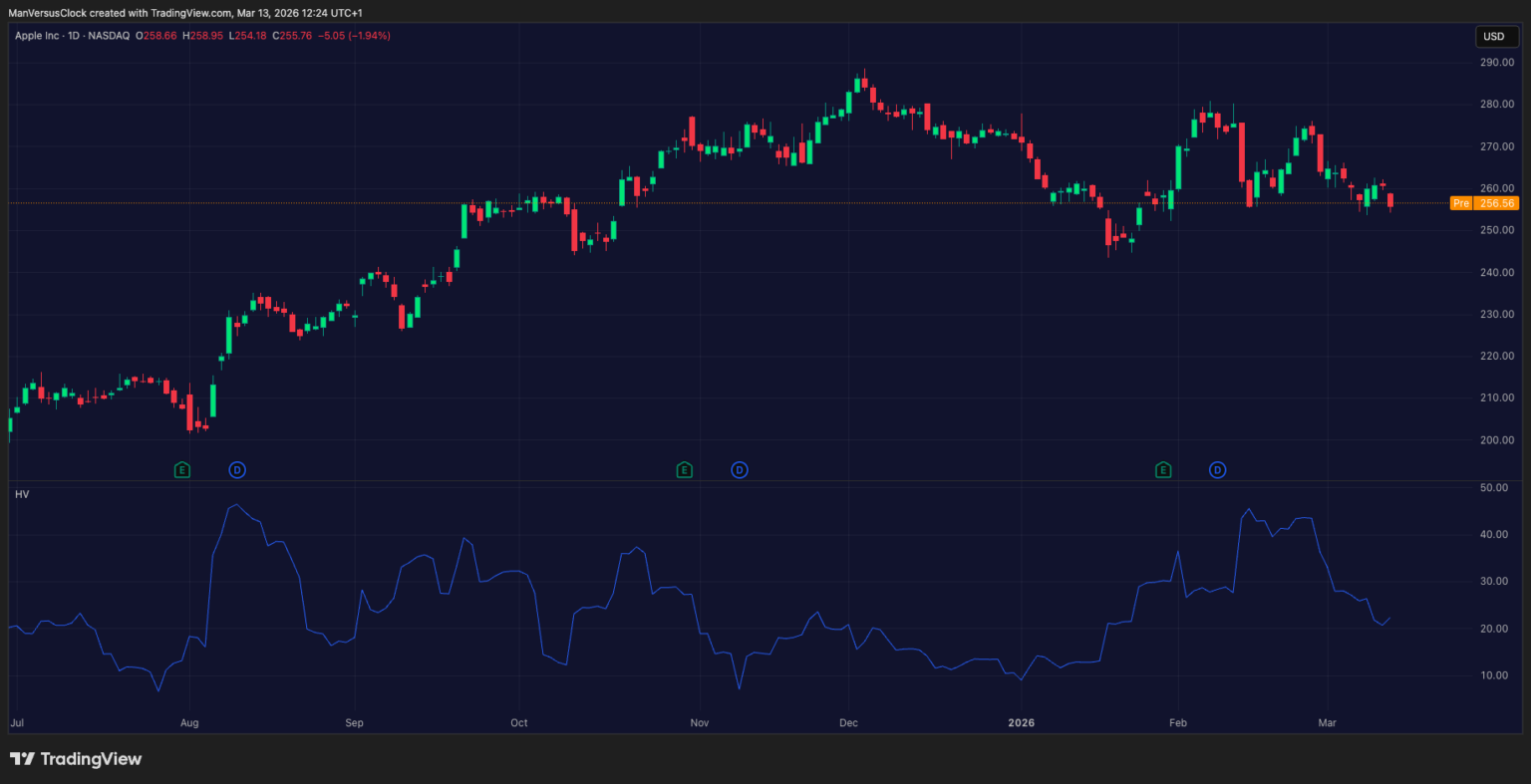
Crypto is the perfect use case. A coin might look calm today, but its 90-day Historical Volatility could reveal that it’s usually a high-energy asset. That’s important because the market personality matters. You should rarely expect stable behavior from something that historically moves like a firecracker.
Read: Top 10 Indicators for the Stock Market in 20254. Chaikin Volatility (CV)
Most traders skip this tool, but it answers a pretty important question: Is this volatility coming from real buying and selling pressure, or is it just noise? It measures the difference between a candle’s high and low with respect to an exponential moving average of that range.
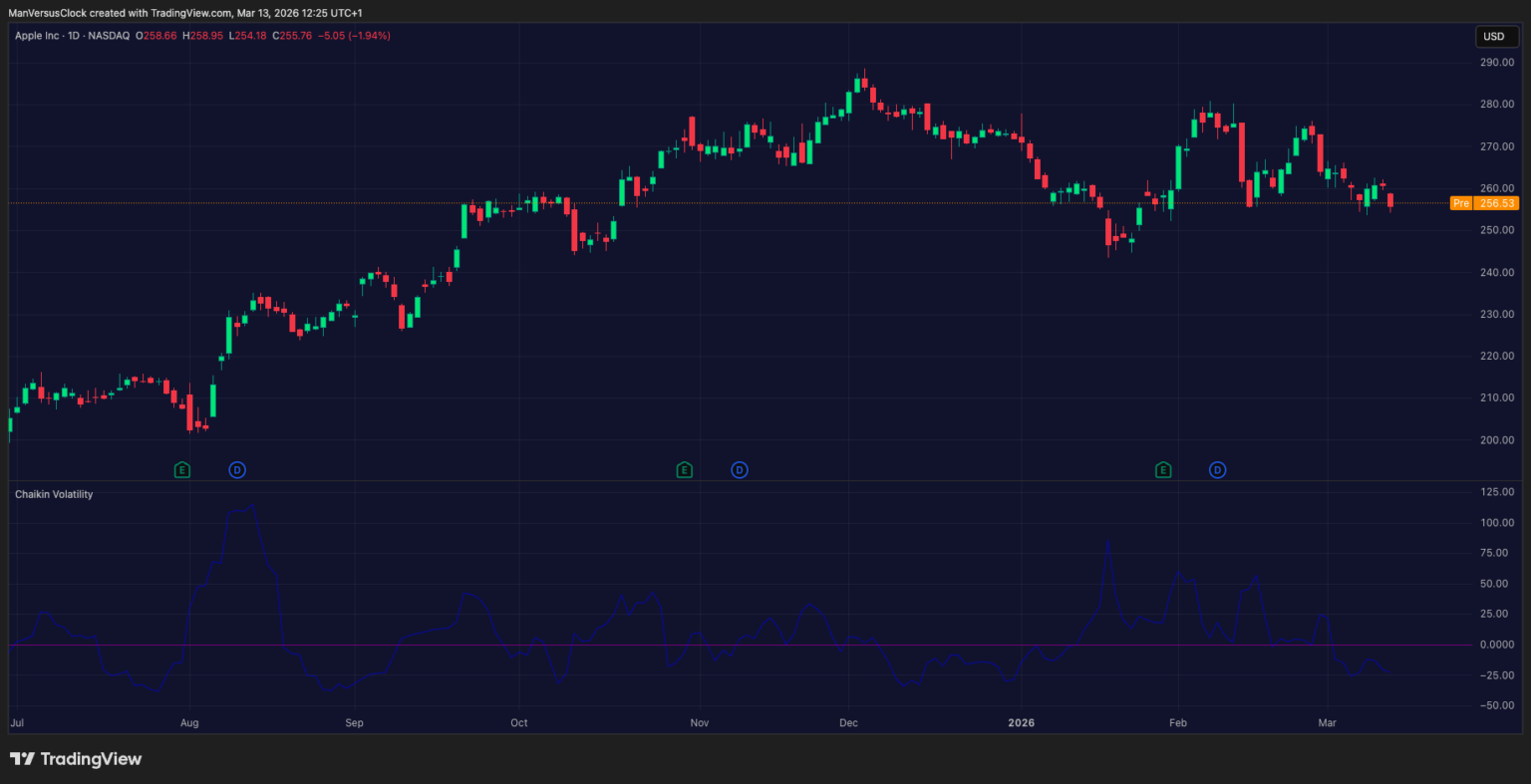
The idea is that volume-weighted volatility tells you whether institutional players are actually involved or if it’s just retail noise moving prices. When Chaikin Volatility spikes, you know something real is happening. Big players are moving, and that’s when you want to be in a trade and not second-guessing your move.
5. Standard Deviation Indicator
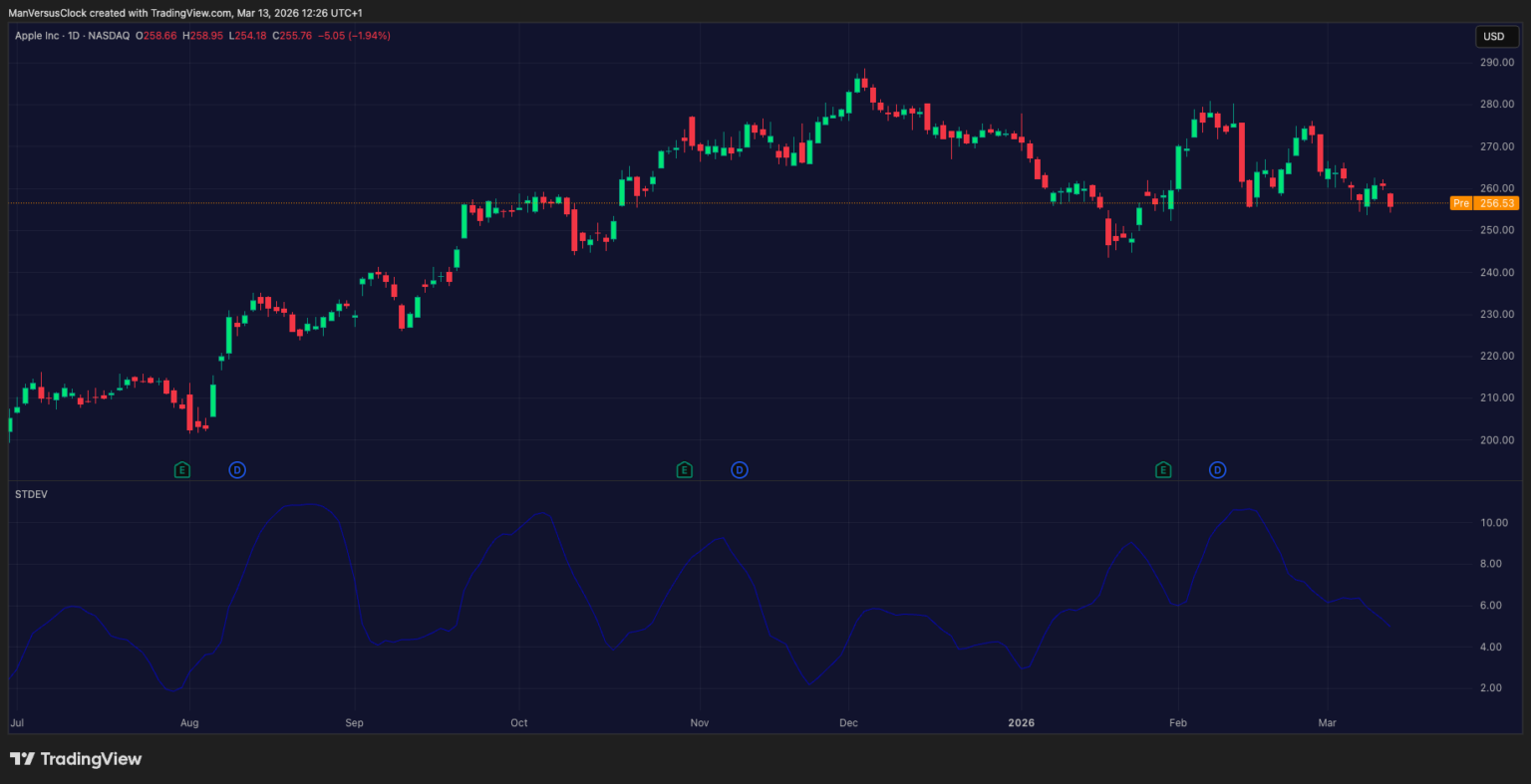
The Standard Deviation indicator measures how spread out the prices are from their average (mean). The larger the standard deviation, the more dangerous the market becomes. When you see standard deviation spike on the chart, that’s visual confirmation that something’s shifted. Volatility is no longer normal.
Modern Indicators to Compound Your Analysis
Classic indicators are great for understanding old-school volatility, but the reality is that markets of today aren’t behaving as they did a decade ago. Crypto moves faster. Stocks react instantly. Liquidity isn’t distributed equally, and volatility doesn’t follow neat textbook patterns anymore.
Most modern indicators, including Zeiierman’s Volatility indicators, are built for today’s trader. For someone competing with algorithms, trading across multiple timeframes, and needing an edge beyond moving averages and standard deviations.
Note: I am, of course, sharing the six we have created and optimized over the years, but you can find scripts from other creators with similar fundamentals behind the scenes.
1. Volatility Trend
Most traders determine trend strength based on price structure, looking for higher highs and higher lows, moving-average alignment, etc. In reality, however, trend health changes inside the volatility profile way before it changes in price. That’s precisely the gap Volatility Trend fills. Instead of tracking price direction alone, it tracks how volatility flows with the trend, and that makes a massive difference because volatility flow often leads price by a step or two.
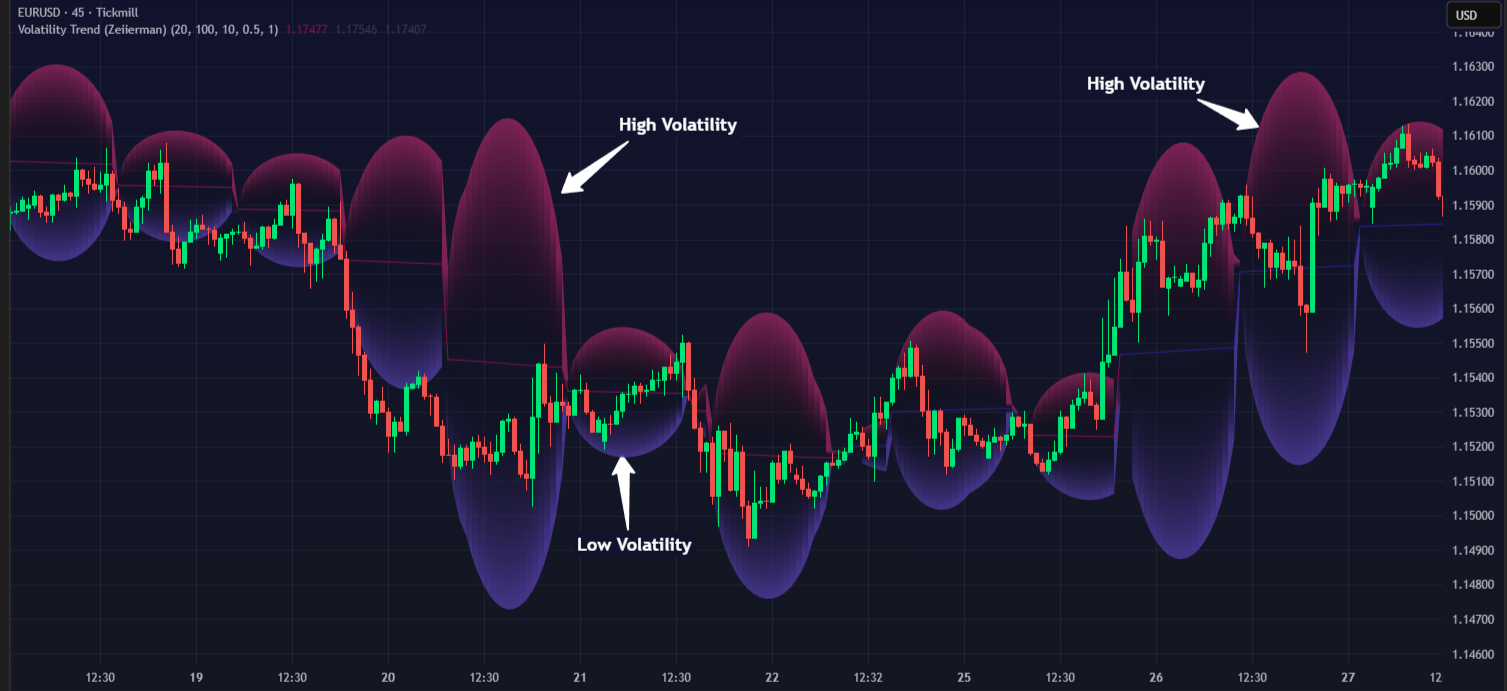
Here’s why most of our community members use it:
- Price can look perfectly bullish even as volatility dies within the move. That’s a classic sign of a trend losing energy. The Volatility Trend reveals that the shift before the candles indicates weakness.
- Not every breakout is real. Some look great on paper but collapse within three candles. Volatility Trend helps filter for breakouts with actual volatility supporting them.
Sometimes the market moves up because volatility has expanded, but it may also move up if liquidity is thin and the price gets pushed. Volatility Trend helps you tell the difference. If you’re a trend trader or swing trader, this becomes one of those indicators you keep on the chart permanently to filter out noise.
Try: Volatility Trend Indicator by Zeiierman on TradingView2. Volatility Impulse (VI)
We made it for the momentum-hunting traders. The Volatility Impulse Indicator is a trading tool that measures the rate of change in an asset’s price volatility. It’s about detecting explosive moves right when they happen. It is designed to identify impulses, which are those sharp, institutionally driven moves that leave retail traders in the dust. It filters out minor fluctuations and highlights candles where significant volume and volatility align.
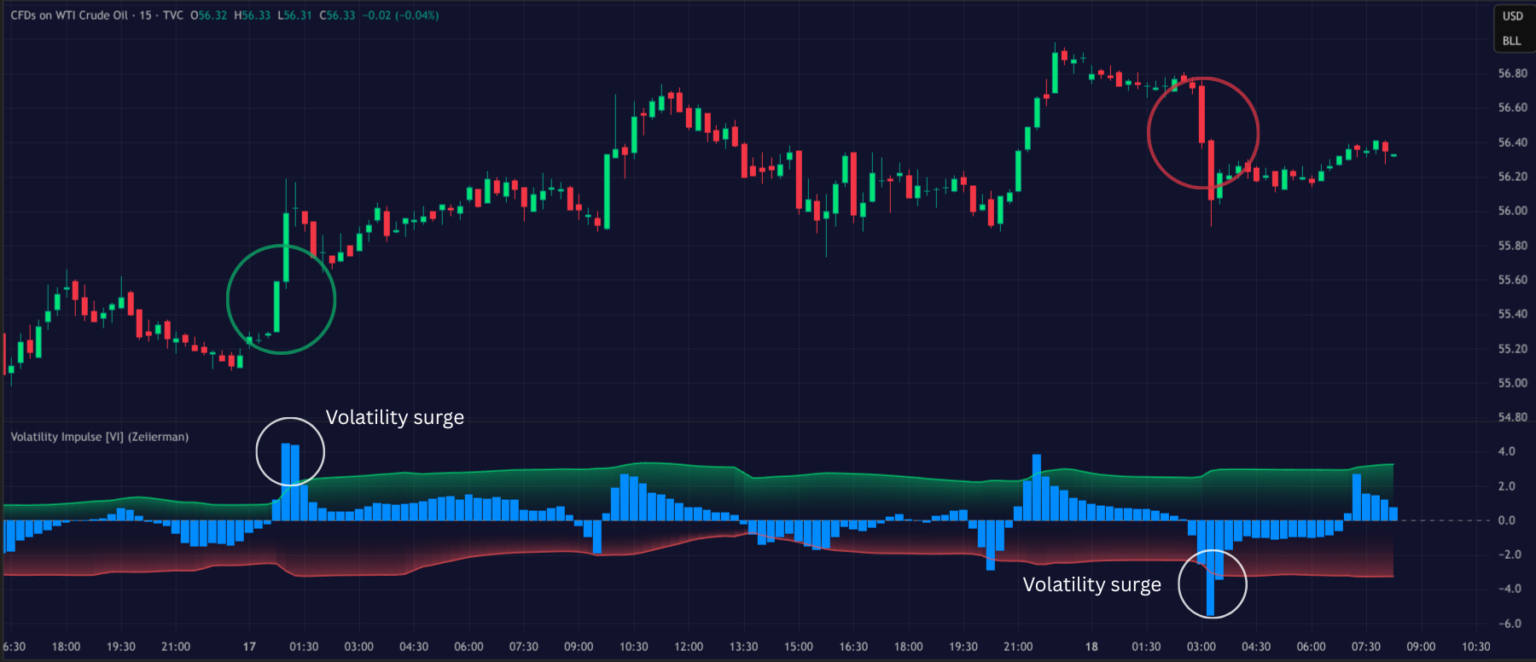
When you see a spike in the VI, it usually means Smart Money has entered the building. It helps you avoid entering a trade on a weak candle. You wait for the impulse confirmation, ensuring you are swimming with the current, not against it.
Try: Volatility Impulse Indicator by Zeiierman on TradingView3. Volatility Index
The Volatility Index is a handy tool for traders, especially those who often go against the current and jump into long positions when prices are low and short positions when they peak. Meanwhile, trend traders usually keep an eye on the overall market trend and use those volatility spikes to jump in during big pullbacks. For those focusing on short-term trends, using the aggressive finder can help spot more minor pullbacks in the market.
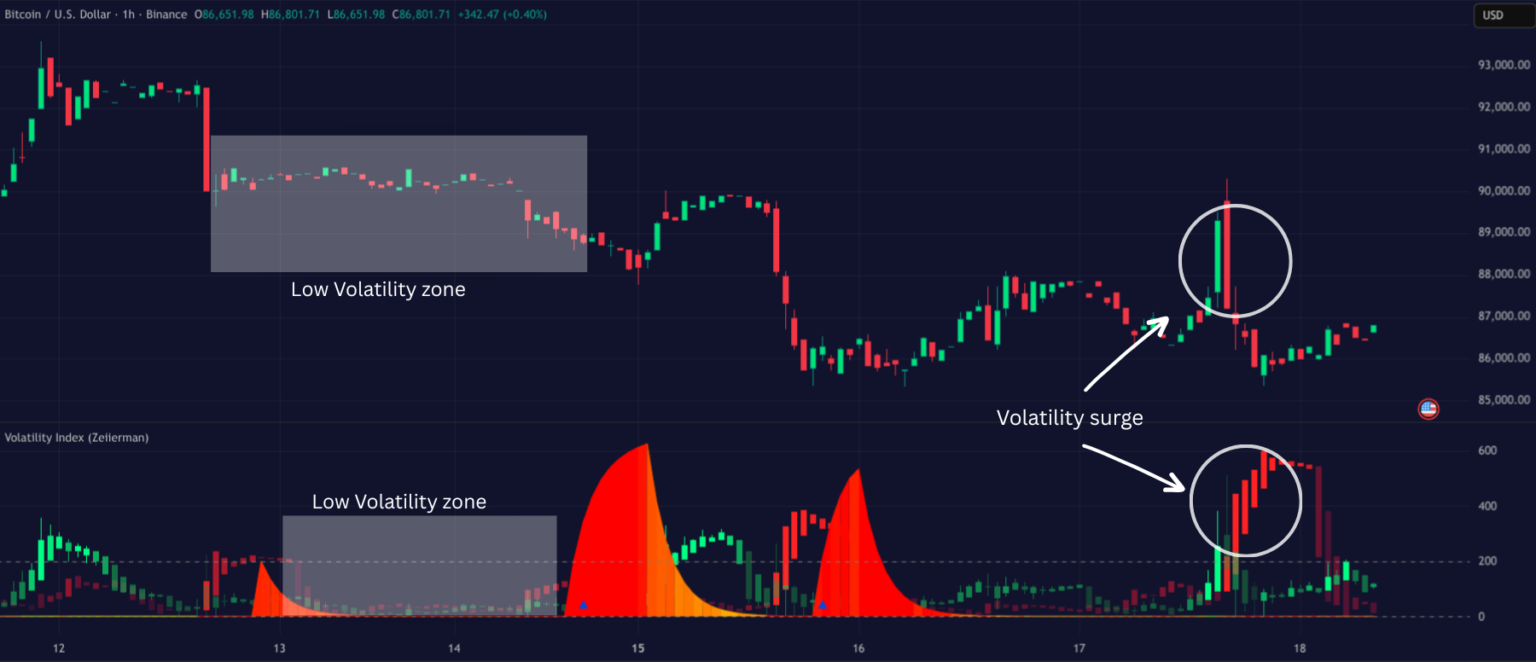
In short, the Volatility Index has something for almost everyone. While ATR measures raw volatility, the index indicator places that information within a trend framework. You can think of it as a volatility oscillator with market-aware intelligence. The best use can be done in these scenarios:
- Trade the expansion phase. When the index rises from a low base, volatility is waking up. This is when breakouts become reliable.
- Avoid the contraction phase. When the index falls, markets enter choppy, mean-reversion territory.
- Use the volatility bottom as a signal. The index, which often forms a rounded bottom, precedes a new trend leg.
- Pair with trend analysis. A strong trend with a rising index usually indicates a safe continuation.
This tool helps you avoid dead markets and focus on the high-probability phases.
Try: Volatility Index Indicator by Zeiierman on TradingView4. Grid by Volatility (Expo)
Grid by Volatility (Expo) automatically builds a dynamic price grid based on the market’s current volatility. Unlike a fixed grid or static levels, this script has spacing between the tool’s bands that expands or contracts depending on how aggressively the market is moving.
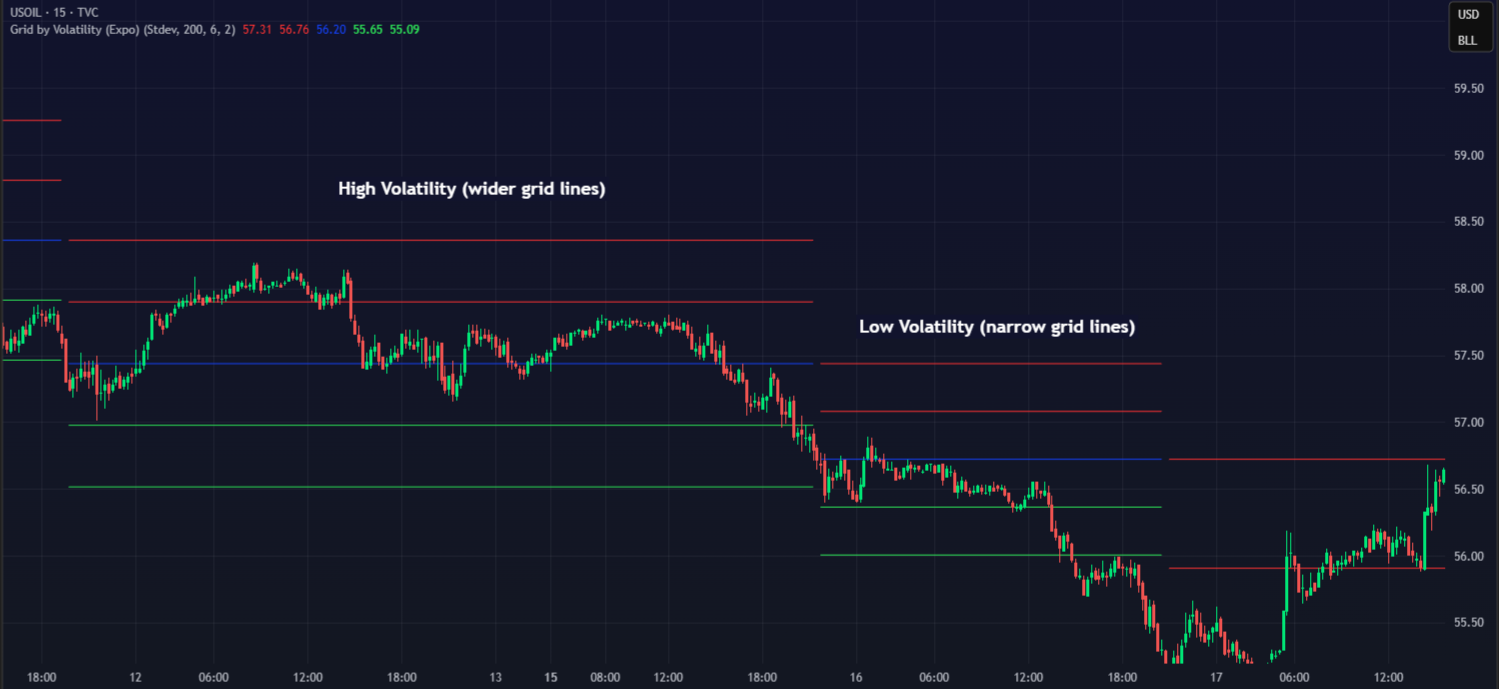
The key to the tool is its volatility-adaptive spacing. Most grid tools use equal distances between levels, which doesn’t really help during trends or sudden expansions. Grid by Volatility adjusts in real time: the grid becomes tighter during consolidation and wider during impulsive moves. It gives you a structure that resembles the market.
Another standout is that it doesn’t assume a direction. It gives you an idea to understand how price behaves relative to volatility rather than just the trend. This tool essentially gives you an early read on volatility rotations, which are often more important than trend direction.
Try: Grid by Volatility Indicator by Zeiierman on TradingView5. Adaptive Volatility-Scaled Oscillator (AVSO)
Standard oscillators (such as RSI or Stochastic) have a significant flaw: they break down during high volatility. They get stuck in overbought or oversold zones for longer periods as the price keeps trending. Unlike those scripts, the Adaptive Volatility-Scaled Oscillator (AVSO) adapts to volatility and scales automatically based on market aggressiveness.
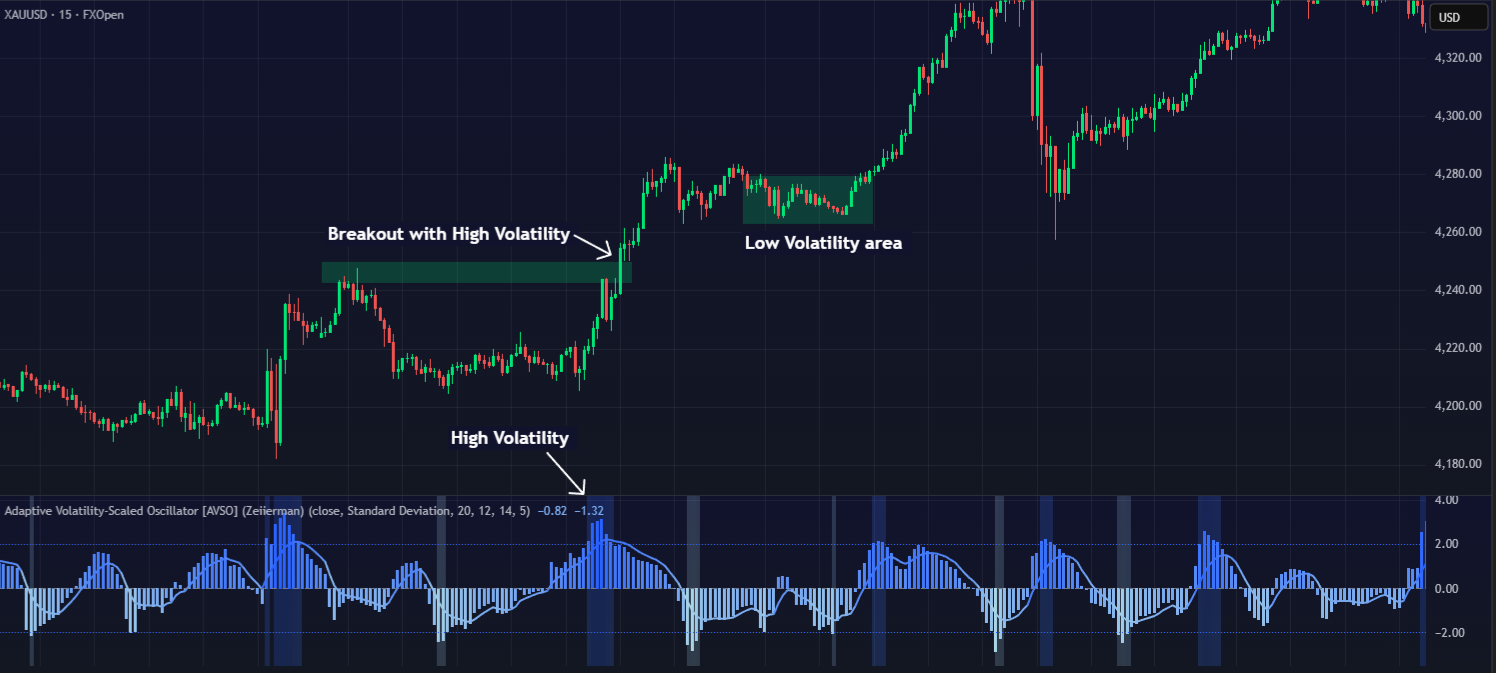
While using this indicator, you can
- Read the slope, not just position. A rising AVSO slope during consolidation signals a trend building.
- Use volatility-adjusted peaks for reversals. When AVSO peaks and rolls over after a strong trend, it usually marks a fundamental shift.
- Ignore traditional overbought or oversold conditions in trendy markets. AVSO handles trends better, so you can use slope changes instead.
- Combine major market structure. When AVSO bottoms near a major support, reversal probability increases significantly.
This tool gives you a pure view of momentum, free from the distortion caused by volatility spikes.
Try: Adaptive Volatility-Scaled Oscillator (AVSO) by Zeiierman on TradingView6. Trend & Pullback Toolkit for Volatility Cycle
The Trend & Pullback Toolkit helps you understand where you are in the natural volatility rhythm of the market. Every trend moves through phases, which include expansion, exhaustion, contraction, and accumulation, and this tool visually maps those phases in the market cycle.
Many traders analyze price but ignore volatility cycles, which is like driving without checking the engine’s temperature. Trend & Pullback Toolkit visually highlights whether the market is charging up or cooling down, making it easier to time entries.
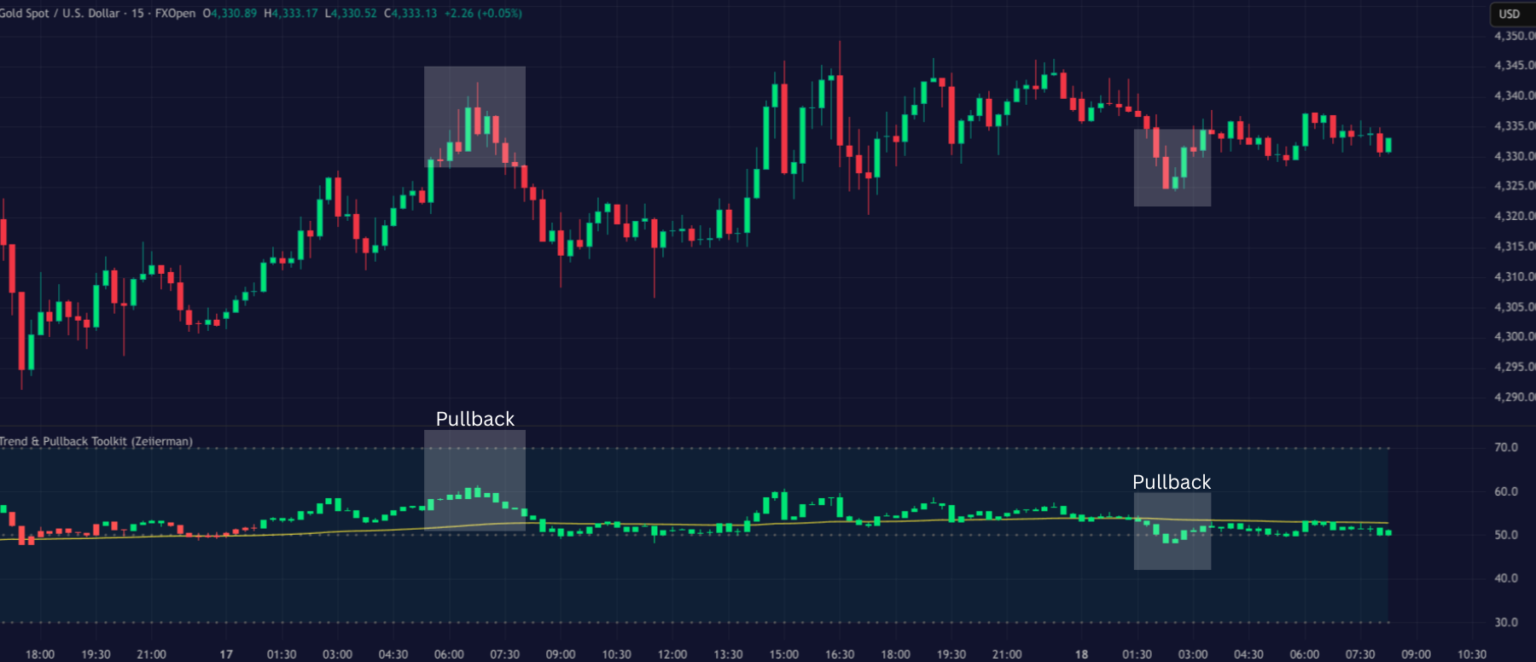
You can take an entry idea when there is a pullback, when volatility bottoms. When the volatility cycle line dips and begins rising, the next trend leg is close. It helps avoid trades when volatility increases well above the default tool line, which often precedes choppy or counter-trend movement.
It’s also helpful in spotting accumulation zones, as flat, low cycles usually signal accumulation before a major breakout. The Trend & Pullback Toolkit is the complete package for traders seeking to detect, evaluate, and act upon market trends and pullbacks while being prepared for major trend shifts.
Try: Trend & Pullback Toolkit by Zeiierman on TradingView
SM_Trader
SM_Trader is a highly experienced coder and strategy developer who brings the most complex algorithms to life. As a member of MENSA, the prestigious organization for individuals with intelligence scores in the top 2% of the world, he combines exceptional analytical skills with a keen eye for numbers and statistics, empowering businesses to grow at the right pace and in the right direction.
More from SM_Trader