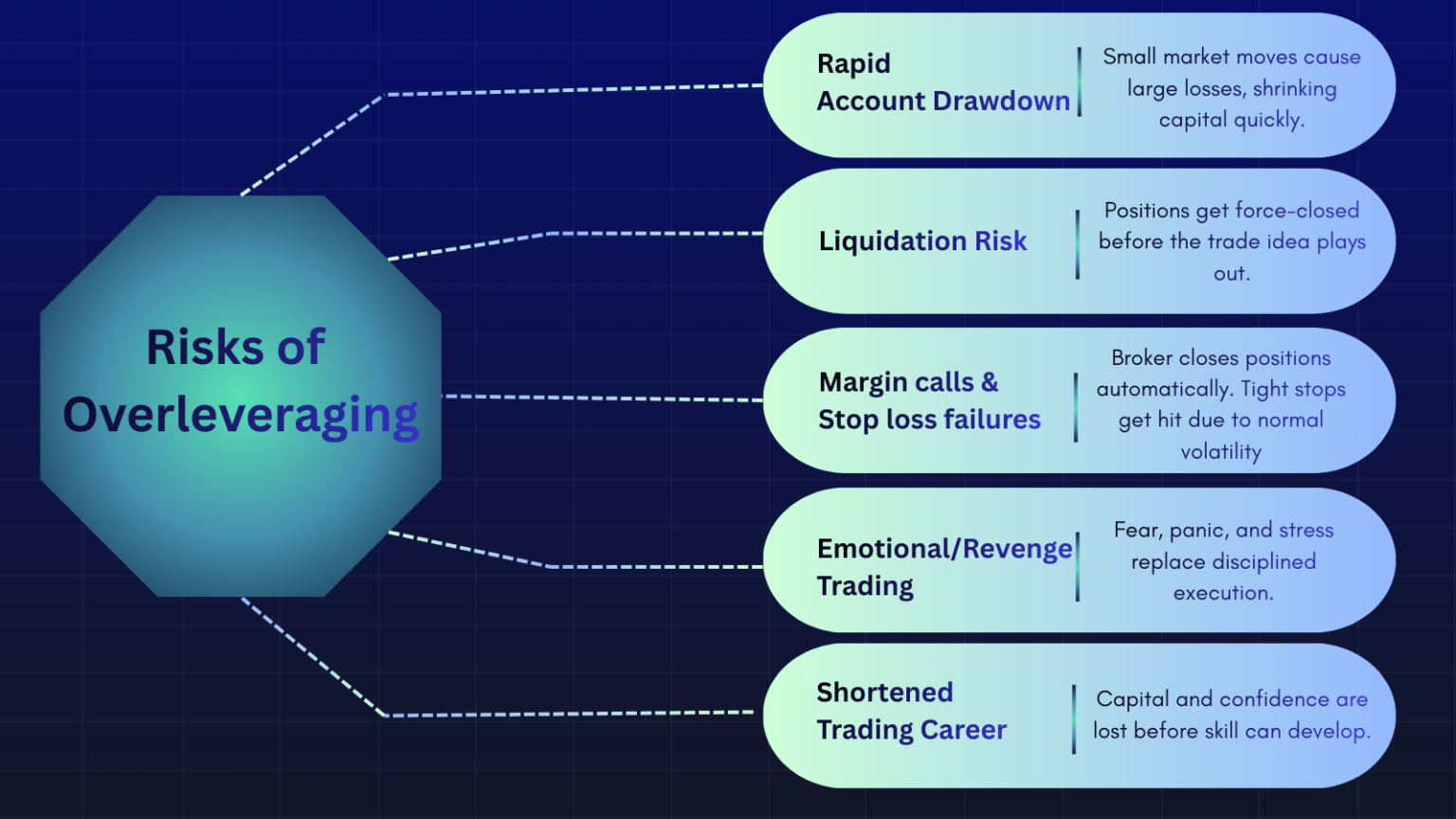
No other mistake can drain a beginner’s trading account faster than overleveraging. Not bad strategies, not poor indicators, not even wrong entries or exits.
You take a small account, apply leverage, and suddenly your profits become meaningful. That first winning trade will make you feel like Belfort in the 80s…until one time the market moves against you, and the whole account goes down the drain.
A scenario like this often occurs when traders start reacting to the market rather than executing the signals they receive. And by the time the trade is closed, the damage is already done, financially and mentally.
The point is, as with many things in life, leveraging is not as hunky-dory as some of these platforms and influencers would make you believe. That said, the most dangerous situation is when you’re overleveraged beyond your risk appetite, either because you don’t know it or because you refuse to acknowledge it.
So, let’s start by knowing what all of this is so you can acknowledge it if and when it happens.
If you don’t want to read the entire article, here’s a quick summary. Though, I do recommend reading it properly once to understand the concept and correct usage of leverage.
Overleveraging is a risk problem, not a leverage problem. It’s about how much of your account you’re putting at risk if the trade fails. A trader using 3x leverage can be far more overleveraged than someone using 15x if their position size is reckless.
Leverage amplifies outcomes, not skill. It doesn’t improve your strategy or accuracy. It only speeds up results. If your risk management is weak, leverage will expose it.
Calculate your position based on how much you’re willing to lose, not how much you want to make. Leverage should be the final adjustment and not the starting point.
High volatility and high leverage are a dangerous combination. Markets like crypto don’t need news to move aggressively. Normal price fluctuations are enough to destroy overleveraged positions, even when the trade idea is correct.
Using all available margin is an account killer. Always maintain a margin buffer to protect you from temporary volatility, prevent forced liquidations, and keep decision-making rational under pressure.
Most trading failures happen because traders don’t last long enough to learn. Overleveraging can shorten your trading career. Controlled risk gives you two things every trader needs: time and experience.
Leverage is a tool for experienced traders, not a shortcut for beginners. Learn to trade profitably without leverage first. When leverage is added later, it should support a proven process, not replace one.
1. Leverage in Trading Explained
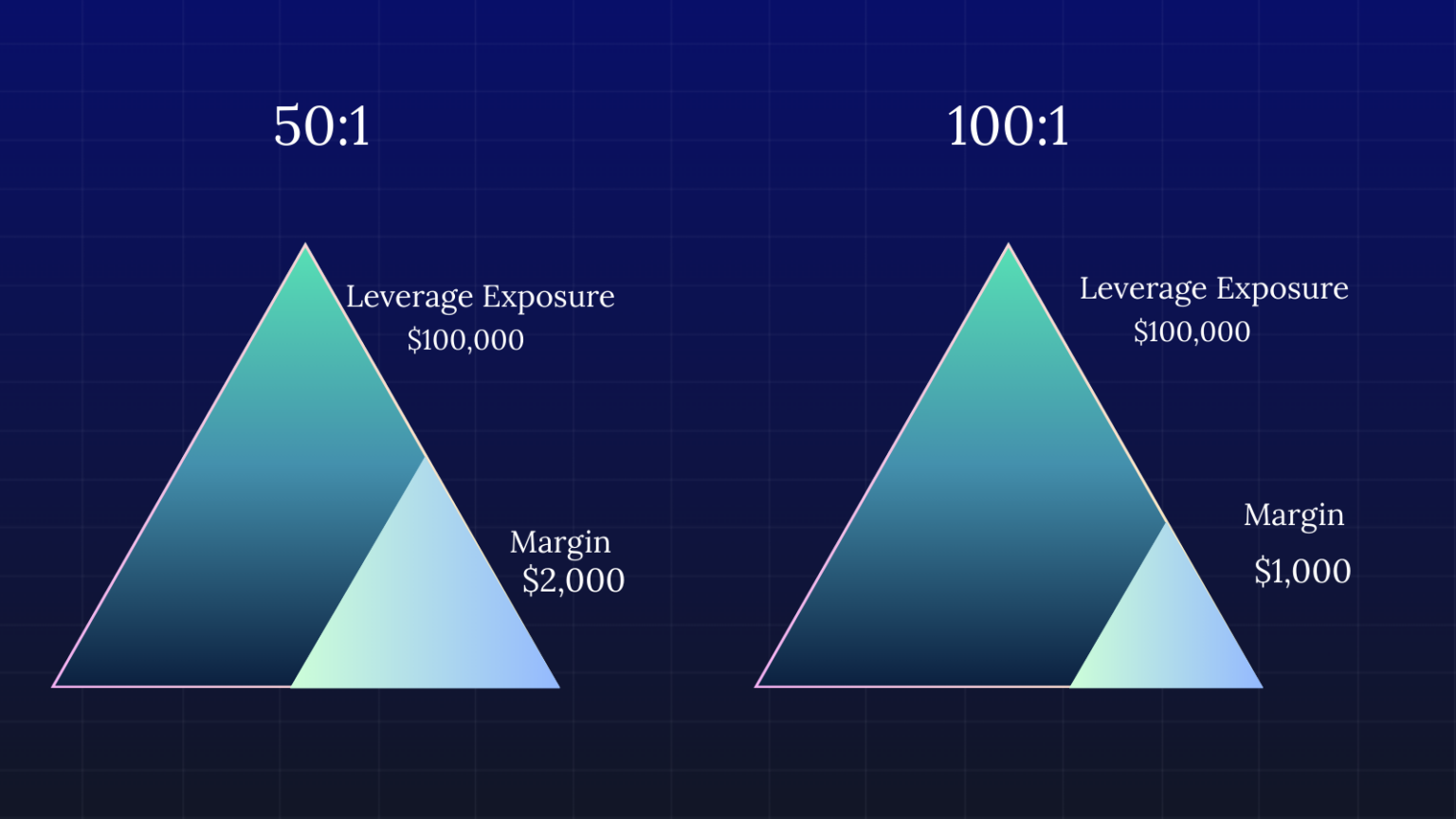
To put it simply, your leverage is a loan from your broker. When you use leverage, you’re borrowing money to increase the size of your trading position beyond your invested capital. And of course, there are some rules around it. You need ‘margin’ to be allowed to use leverage, which is like a good-faith deposit required to open a position.
Suppose you have $10,000 capital with a 2% margin requirement. This is a leverage ratio of 50:1, which brings your total position size to $500,000 ($10,000 * 50).
📌 Note: Leverage Ratio is the reciprocal of your margin requirement. For example, the reciprocal of 2% is 50.
Now, let’s say you made an initial trade and bought EUR at 1.16 USD. The total EUR bought would be roughly €431,034 ($500,000 / 1.16).
Scenario 1: Market moves in your favor.
Exchange rate increases from 1.16 to 1.17
New position value is $504,310 (€431,034 * 1.17)
Net profit becomes $4,310
ROI is 43.1% ($4,310 / $10,0000)
Scenario 2: Market moves against you.
Exchange rate decreases from 1.16 to 1.15
New position value is $495,670 (€431,034 * 1.15)
Net loss becomes $4,330
ROI is negative 43.3% ($4,330 / $10,0000)
In real life, different markets offer different levels of leverage. Stock trading typically offers 2:1 or 4:1 leverage. Futures markets might offer 10:1 or 20:1. Forex trading can go as high as 500:1, and cryptocurrency exchanges commonly offer 100:1 or even 125:1 leverage.
Leverage amplifies both your gains and losses equally. With 100:1 leverage, a 1% move against you wipes out your entire account. This is why leverage is a double-edged sword in the trading world.
A. What is a margin call?
If your account falls below the Maintenance Margin, the broker will hit you with a Margin Call, or worse, liquidate your position entirely to protect their own capital.
Continuing with the example above, a 2% MMR (Minimum Margin Requirement) means the equity in the trader’s account must be above 2% of allowed capital, which is $10,0000 ($500,000 * 2%). Otherwise, the broker may issue a margin call.
In the second scenario, where you incurred a $4,330 loss, you were left with $5,670 in your account. A margin call will then be triggered, since the remaining equity ($5,670) is below the required maintenance margin ($ 10,000). You must then deposit additional funds to return the equity to the required level, or the broker will liquidate positions to cover the shortfall.
B. What does Overleveraging really mean in trading?
In the realm of social media and fast-paced content, ‘using too much leverage’ has become the de facto definition of ‘overleveraging.’ But there’s more to this concept.
You’re considered overleveraged in trading when the size of your position exposes your trading account to more risk than it can reasonably absorb if the trade fails. It basically means when a trader bites a larger bite of the market than their risk appetite. This risk includes both financial and emotional risk.
Some say you are overleveraged at 50x leverage, but actually, you can also be overleveraged at 3x leverage. The leverage number alone does not define the risk. What matters is how much of your total capital is at stake if the trade hits your stop-loss or liquidation level.
Here are a few indicators (pun-intended) of overleveraging for you to use as a checklist:
Using all your available margin on one or two trades
Taking positions where a 2-3% market move could wipe out 25% or more of your account
Being unable to place proper stop losses because they would be too large
Having no capital buffer for when trades move against you
Trading with money you can’t afford to lose
The key difference which everyone must understand is that a professional trader might use 50:1 leverage but only risk 1% of their account per trade. A beginner might use 10:1 leverage but risk 50% of their account on one position.
As you may have noticed already, the beginner is overleveraged despite having a lower leverage ratio. It’s pertinent to look at how much leverage you’re using actively rather than the amount of available leverage.
2. Are you overleveraged right now? – A Checklist
You have carte blanche to trade with your account as you wish, but doing it recklessly (with excessive leverage) will undoubtedly lead to debt or worse. As such, here’s a quick ‘checklist’ you can use to see whether you’re overleveraged and in over your head right now.
Check #1: Frequent Margin Calls. Your positions are likely too big for your account size if you’re receiving frequent margin calls from your broker.
Check #2: Significant Account Drawdowns. Large drawdowns, say losing over 20% of your account, are a red flag that suggests that your positions are (maybe) too large or the risk is beyond your current appetite.
Check #3: Emotional Stress. Constantly worrying about your trades going awry could be a sign of overleveraging, especially if it’s affecting your sleep.
Check #4: Inability to Diversify. Overleveraging often leaves little room for diversification. And putting your capital in a few highly leveraged positions is surely a high-risk endeavor.
Check #5: Commodity and your position. The common leverage in forex tends to be much higher than that in stock trading. This is partly because no tangible asset is being purchased or sold here.
In forex trading, each transaction involves two currencies, and the value of one currency is always relative to another. When you open a position in the forex market, there’s no initial net value because you’re simultaneously buying one currency and selling another.
3. How to avoid being overleveraged?
In my experience, and based on what I have seen among traders in our Zeiierman Trading community, there are three most significant contributors to overleveraging. If you can understand them and actively avoid them, you have a far greater chance of not being overleveraged.
A. Unrealistic Profit Expectations
New traders often come to the market expecting to turn $1,000 into $100,000 in a few months. It’s certainly normal to think of that as a possibility, especially if you frequent social media sites.
You hear about the one trader who turned $5,000 into $500,000 using aggressive leverage, but you won’t hear about the other 99 who ended up with their account (and savings) wiped. These unrealistic expectations can make you see overleveraging in a relatively positive light. How else will you make quick cash after all?
Reality: Professional targets vary widely, but they do have consistently controlled drawdowns and small, repeatable edges rather than lottery-ticket growth. If you can consistently make 2-3% per month, you’re doing exceptionally well.
B. Broker Marketing
I once read a quote from Seth Godin: “Marketing is a contest for people’s attention.” And the best way to get someone’s attention is by selling them a dream.
That is why high leverage is marketed as a feature rather than a warning. Brokers advertise 500:1 leverage like it’s a benefit. They make money from your trading volume, not your success, so they have no incentive to discourage you from using maximum leverage.
I tell new traders to keep a trading diary that clearly lists their risk management and risk appetite. And that includes a simple lesson: just because leverage is available doesn’t mean you should use it.
C. FOMO (Fear of Missing Out)
The market is exploding, everyone is making money, and you need to jump in right now with a prominent position, or you’ll miss your chance. Seems familiar? Yeah, that’s all day, every day.
FOMO will make you believe that a few moves are enough, and you will be out of the trade. However, it doesn’t let you see that the trade may go against you and blow your account or damage it severely in fewer moves. Trades made out of FOMO are rarely well-managed in terms of risk.
If you’re feeling that you missed a BIG opportunity and you need to catch whatever is left right now, that’s your signal to slow down. The best opportunities come when you’re calm and analytical.
I am sure you have already seen a pattern by now. All three of these points point to the same issue: overleveraging happens when a broker or influencer sells you a one-in-a-million dream, while you lack the patience and/or experience to catch the exaggerations.
Okay, enough scaring. Leverage is not inherently dangerous. I use it myself. The destruction may (or may not) occur when it’s used without a proper framework or plan in mind. Responsible leverage use starts before you open a trade, not after you see an interesting setup.
Here’s a quick step-by-step trading journey that I have brielfy drawn for you:
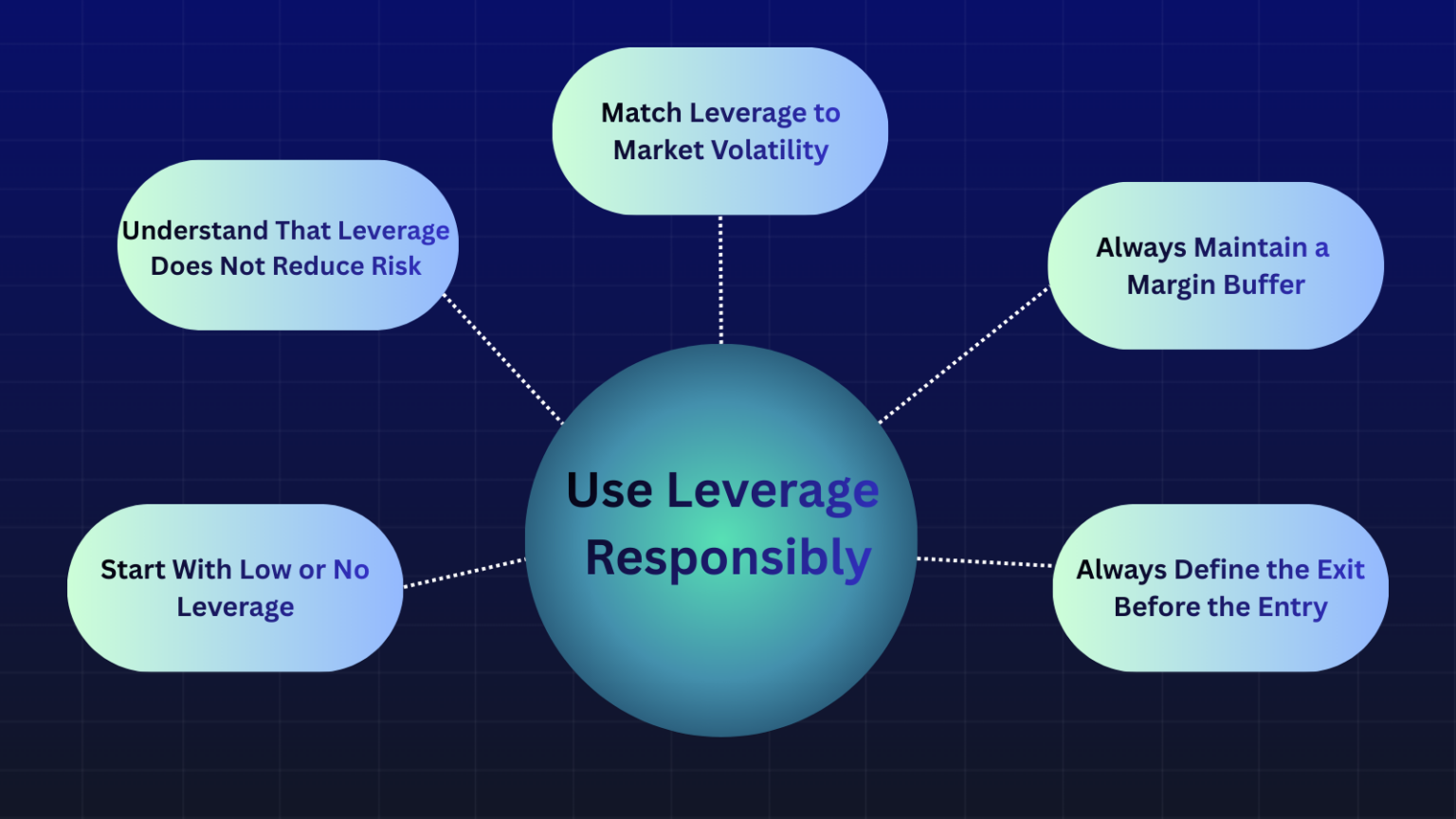
A. Start With Low or No Leverage
When you’re learning, trade with your actual capital. Don’t use leverage simply because it’s available. Prove you can be profitable without leverage before adding it to your trading.
First, decide how much of your account you are willing to risk on a single trade. For most beginners, this should be around one to two percent of total capital. This level of risk allows you to take losses without emotional disruption and without damaging your long-term equity curve.
Suggested Timeline:
First 3-6 months: Trade with no leverage
After consistent profitability and learning, you can consider a maximum leverage of 2:1 or 3:1.
Gradually increase after 12+ months of continued success, and if your strategy supports it.
B. Leverage Doesn’t Affect Risk
One of the most common misconceptions among beginners is believing that leverage somehow changes risk. It does not. Leverage only changes how much capital you need to control a position, not how much you lose when the trade fails.
If your position size is too large relative to your account, the trade is risky whether you use 2x leverage or 20x leverage. The danger comes from exposure, not from the leverage label itself. Responsible traders focus on exposure first. They know precisely how much a trade will lose if the stop is hit, and should be comfortable with that loss before sending the order forward.
📌 Expert Tip: Don’t adjust your leverage if you’re uneasy about the potential loss. The solution is to reduce position size.
C. Match Leverage to Market Volatility
Keep in mind that different markets behave differently. It’s best to be flexible about your leverage and make a decision based on market type and conditions. This flexibility will keep drawdowns manageable.
Highly volatile markets like crypto can move by several percentage points in minutes, even without news. Using high leverage in these conditions leaves no margin for normal price fluctuations. A trade can be correct in direction and still fail because the position size was too aggressive for the volatility.
More stable markets, like some indices during regular trading hours, can allow slightly higher leverage because price movements are more controlled. Even then, leverage should be adjusted smartly and dynamically, not fixed.
Stop distance
Leverage
% move to −1R
Account hit at stop
0.5%
5×
0.5%
1%
1.0%
5×
1.0%
1%
1.0%
10×
1.0%
1%
2.0%
2.5×
2.0%
1%
(Shows that R is sizing-driven; leverage just changes capital tied up.)
D. Maintain a Margin Buffer
Never use all your available leverage. If you have $10,000 in buying power, don’t open $9,500 worth of positions. Keep at least 50% of your margin available as a buffer.
By hedging your bets like this, you’ll prevent margin calls from temporary price movements and have the flexibility to add to winning positions if an opportunity presents itself. As a plus point, it also reduces stress and anxiety.
E. Define Exit Before Entry
Responsible leverage use requires clarity on how the trade ends before it begins. Before you make the order final, every leveraged trade should have a clearly defined stop-loss, a position size calculated based on the stop, and an acceptable maximum loss.
If any of these elements are missing, leverage becomes a double-edged sword. Deciding your exit after the price has already started moving eventually leads to moving stop-losses, holding losing trades too long, or getting liquidated unexpectedly.
With over 16 years in the market, Zeiierman has extensive experience as a full-time trader and risk advisory consultant for hedge funds. He has developed many profitable trading strategies, drawing on his background in risk management and strategy execution.